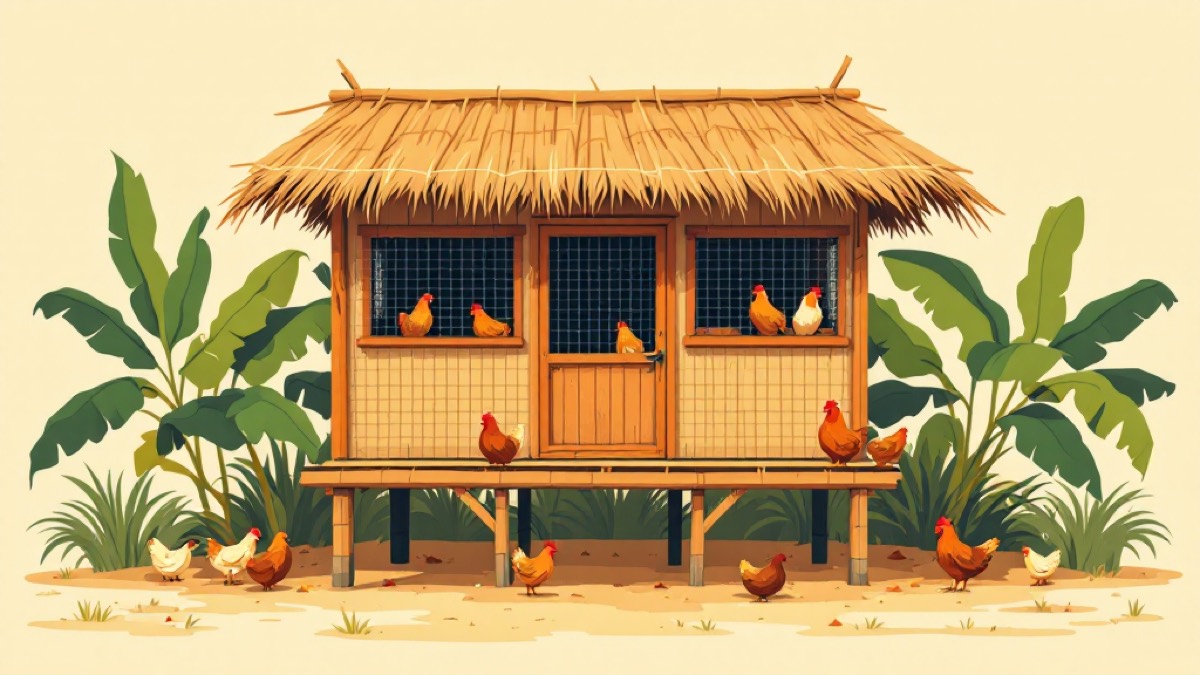
Chicken Tractors: Moving the Birds Instead of the Manure
TL;DR: A chicken tractor is a floorless pen you move to fresh ground — birds get new forage, manure is spread rather than accumulated, and parasites do not build up because birds never return to fouled ground. The costs are real: you move it every day, it holds fewer birds than you think, and in the Philippines a light structure means shade must be built in and typhoons must be planned for. The ground tells you when to move it, not the calendar.
The system that trades a daily chore for most of the problems fixed pens create.
The Idea
A fixed pen concentrates everything in one place: manure, parasites, bare ground. Over time that is the source of a large share of the health problems on this site.
A chicken tractor inverts it. Move the birds instead of the manure.
What follows:
- Fresh forage every move — greens, insects, seeds the birds find themselves.
- Manure distributed across ground that can use it, rather than accumulating — see poultry manure as fertilizer.
- Parasite pressure reduced, because birds are not repeatedly returning to ground they have contaminated. That matters for internal parasites, coccidiosis and gapeworm, all of which depend on birds re-encountering their own or each other’s droppings.
- No litter to manage, which removes the wet-litter problem entirely — see chickens in the rainy season.
That parasite point is the strongest argument for the system and the one most often understated.
What It Costs You
You move it. Every day. Not most days. A tractor that stops being moved is a very small, very bad fixed pen with no floor and no litter.
It holds fewer birds than you expect. The whole mechanism depends on the ground recovering between visits. Overstock it and you are back to bare fouled ground, just in more places.
Less protection than a solid coop. See predators, below.
Less shelter, which in this climate is not a small thing.
The Philippine Adjustments
Two, and neither is optional.
Heat. A light structure in tropical sun is an oven. Shade cannot be an afterthought — it has to be built into the design, with a solid roofed section the birds can always get under, and it has to be positioned with the sun in mind at every move. See keeping chickens cool, heat stress and raising chickens through a Philippine summer.
A tractor sited in the open at midday is a serious welfare problem, and heavy or densely feathered breeds should not be in one at all — see Buff Orpington and Brahma.
Typhoons. A structure light enough to move by hand is light enough to be moved by wind. It must be anchored, or moved to shelter before a storm, and that plan needs to exist before the season. See typhoon-proof chicken coop.
Predators
Weaker than a solid coop, and the weakness is specific.
The gap where the frame meets uneven ground. A tractor sits on whatever surface it is on, and Philippine ground is rarely flat. Every move creates new gaps.
| Threat | Where it gets in |
|---|---|
| Dogs | Digging under, or through light mesh |
| Snakes | Any gap; chicks and eggs are the target |
| Rats | Gaps, and drawn by feed |
| Hawks | Overhead, if the top is open mesh |
Mitigations: a skirt of mesh laid flat around the base, heavy enough mesh throughout, a secure enclosed section for night, and choosing ground that is reasonably level. See chicken predators in the Philippines.
Night is when losses happen. A tractor with a closable, solid night section is a very different proposition from one that is mesh all round.
Building One
No plan here, because it depends entirely on your ground, your flock size and what materials you can get. The principles that decide whether it works:
- Light enough for one person to move, or it will not get moved.
- Wheels or skids, sized for your actual terrain.
- A solid roofed section for shade and rain — non-negotiable here.
- A closable secure area for night.
- Feeder and drinker that travel with it — see chicken waterers and chicken feeders.
- Mesh skirt at the base.
- Anchor points for storms.
Compare with chicken coop design, poultry housing design and low-cost poultry farm design for the fixed alternatives.
When to Move It
The ground tells you. Move before it goes bare and fouled, not after. That interval depends on your stocking density, the weather, the season and what is growing.
Watch for: bare patches, droppings accumulating visibly, birds no longer finding anything. Any of those means you left it too long.
Rotate deliberately rather than wandering, so ground gets a real rest — and keep a simple record of where it has been. See chicken record keeping.
Where It Fits
| System | Suits |
|---|---|
| Fixed coop and run | Most backyard flocks; simplest |
| Chicken tractor | Small flocks, land available, daily attention |
| Free range | Land, and acceptance of losses |
| Pastured poultry | The scaled-up version of this idea |
| Layer cages | Commercial egg production |
A tractor is genuinely good for a small flock on land you want fertilised anyway, kept by someone who is out there every day regardless. It is a poor fit for anyone who is not.
The Honest Limits Here
That a chicken tractor is a floorless mobile pen moved to fresh ground, that moving birds reduces parasite build-up and distributes manure rather than concentrating it, and that light mobile structures offer less predator protection and less shelter than fixed housing, is established smallholder practice. This guide gives no dimensions, stocking figures, materials list or move interval — all of them depend on your flock, your land and your climate, and the condition of the ground is the instruction. In Philippine conditions, built-in shade and a typhoon plan are requirements rather than refinements.
Related: pastured poultry, chicken run design, typhoon-proof chicken coop, free-range native chicken farming.
Frequently Asked Questions
What is a chicken tractor?
A floorless mobile pen moved to fresh ground regularly, so birds get new forage and their manure is spread over the ground rather than accumulating in one place.
What are the advantages of a chicken tractor?
Fresh forage, manure distributed rather than accumulated, reduced parasite build-up because birds are not returning to contaminated ground, and no litter to manage.
What are the disadvantages?
It has to be moved, every day. It offers less protection than a solid coop, it holds fewer birds, and in the Philippines heat and typhoons are both harder to manage in a light structure.
How often should a chicken tractor be moved?
Frequently enough that the ground under it does not become bare and fouled. The condition of the ground is the instruction rather than a fixed interval.
Do chicken tractors work in the Philippines?
They can, with attention to shade and to typhoon anchoring. A light mobile structure in tropical heat needs real shade built into it, and it must be secured or moved before a storm.
Are chicken tractors predator proof?
Less so than a solid coop. The gap where the frame meets uneven ground is the weak point, and digging predators are the main concern.
How many birds fit in a chicken tractor?
Fewer than people expect, because the whole system depends on the ground recovering. Overstocking defeats the purpose.