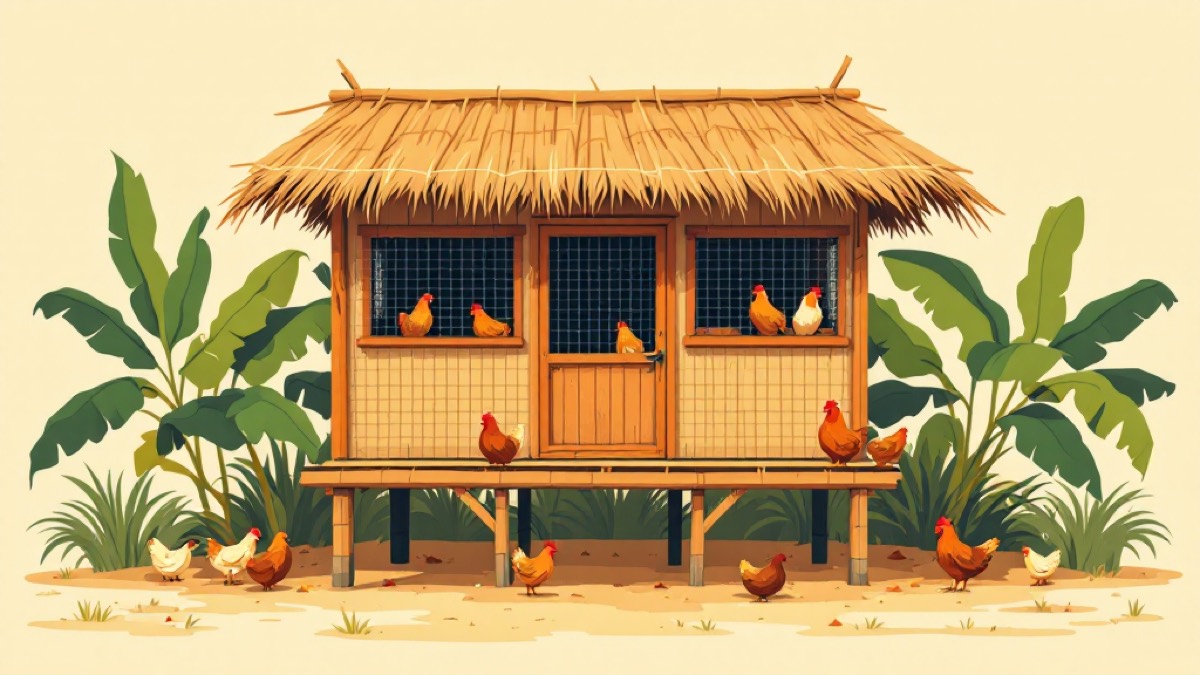
Chicken Coop Design for a Philippine Backyard
TL;DR: A backyard coop for the Philippines needs a raised floor (15-20 cm minimum), a GI sheet roof with 30-45 cm overhang, wire-mesh openings on at least two sides for cross-ventilation, and buried mesh around the base to stop digging predators. Bamboo and wood keep material choices flexible; the details that actually protect the flock are drainage, airflow, and how solidly the frame is anchored before typhoon season.
Most backyard coop designs you’ll find online come from cooler climates, where the goal is keeping birds warm. That’s the wrong problem here. In the Philippines the coop has to survive standing water, ninety-percent humidity, and a typhoon track that runs through most of the country every year — while still keeping predators out at night.
This is a practical design walkthrough, not a build plan with exact dimensions for every yard. Pair it with our gamefowl farm design and layout guide if you’re planning a multi-bird setup with separate zones — the zoning and drainage principles there apply to any backyard coop, not just gamefowl. This guide focuses on a single coop structure.
What Should a Philippine Chicken Coop Be Made Of?
Bamboo or wood framing with GI sheet roofing is the standard combination, and for good reason — it’s workable with basic tools, widely available, and GI sheet sheds rain far more reliably over time than thatch.
Framing. Bamboo is light, cheap, and easy to cut and lash or nail into shape. Coco lumber and other wood framing cost more but last longer and hold screws better at stress points like door hinges and roof joints. Either works; the choice is mostly about what’s locally available and your budget for replacement versus upfront cost.
Walls. Wire mesh (chicken wire for general enclosure, hardware cloth for anywhere a predator could push through) on at least two sides gives you airflow without giving up security. Solid walls on the remaining sides block wind-driven rain and give birds a place to get out of a direct downpour.
Roofing. GI sheet is the standard choice for a reason — it’s durable, sheds rain completely, and needs no maintenance beyond checking for rust or loose fasteners after a storm. Nipa or cogon thatch is cheaper and keeps the coop cooler under direct sun, but needs more frequent replacement and doesn’t hold up as well through a full rainy season. Neither is objectively “better” — it’s a straightforward trade of upfront cost against how often you’re willing to redo the roof.
Flooring. A raised, slatted or wire-mesh floor over packed earth is the standard for a small backyard coop. It lets droppings fall through or be swept out, and dries fast after rain. See chicken coop flooring and cleaning for a full comparison of flooring options and how cleaning cadence changes with each.
How Should the Roof Be Designed?
The roof’s two jobs are keeping rain off the birds and not becoming a sail in a typhoon — get both right and most other roof decisions are just preference.
A single or double-pitched roof sheds water faster than a flat one, which matters more in the Philippines than almost anywhere. Overhang should run 30-45 cm past the walls — enough to keep wind-driven rain off feeders and bedding near the wall line, but not so much that a gust can get underneath and peel the sheet off. Fasten GI sheet with enough screws or nails along every purlin, not just the edges — a roof that loses one screw in a storm tends to lose the whole sheet.
If heat is a bigger daily concern than rain in your area, a raised ridge vent or a small gap at the roof peak lets hot air escape without letting rain in — see chicken coop ventilation for why that matters more than most backyard raisers expect.
How Do You Handle Drainage and Flooding?
Standing water under or around a coop is what actually kills birds and drives disease — not the rain itself.
Site selection first. Build on the highest, best-drained spot available, not the flattest or most convenient one. If the yard floods every rainy season, that’s the one spot to avoid, even if it means a smaller footprint elsewhere.
Raise the floor. A minimum 15-20 cm clearance between the coop floor and the ground keeps bedding dry and out of reach of surface water during a normal downpour. In flood-prone barangays, raise it further — 30 cm or more isn’t excessive.
Slope and channel. Grade the ground around the coop so water runs away from it, not toward it, and dig a shallow drainage channel on the uphill side if the yard has any slope at all. This is the same principle covered in more depth in the farm design and layout guide — it applies at the scale of one coop just as much as a multi-pen farm.
How Do You Predator-Proof a Backyard Coop?
Dogs, cats, rats, snakes, and birds of prey are the realistic predator list for a Philippine backyard, and each one exploits a different weak point.
| Predator | Main entry point | Fix |
|---|---|---|
| Dogs and cats | Loose or torn wire mesh | Use hardware cloth, not chicken wire, on any panel a paw can reach |
| Rats | Gaps under walls or around the door frame | Seal gaps over 2 cm; rats can squeeze through surprisingly small openings |
| Snakes | Any opening large enough for a rat, since snakes follow rat trails | Same mesh and gap-sealing fixes as for rats |
| Birds of prey | Open-top runs with no overhead cover | Cover open runs with mesh or netting, especially for chicks and small breeds |
Bury the perimeter. Dig a trench around the coop base and bury wire mesh at least 15 cm deep, or fold it outward along the ground and stake it down, to stop digging predators from tunneling under the wall.
Close it fully at night. A coop that’s secure at 6 PM but left open at 9 PM is not predator-proof. Whatever door or hatch system you use, it has to close completely, every night, without relying on memory.
What Changes During Typhoon Season?
A coop that survives an ordinary rainy season can still fail in a typhoon, because wind load is a different problem from water load.
Anchor, don’t rest. Sink corner posts into the ground (with concrete footing if the budget allows) rather than setting the frame on top of hollow blocks or stones. A structure that can be pushed or lifted is a structure that will be, in a strong enough gust.
Bolt the load-bearing joints. Nails work loose under repeated wind stress; screws or bolted connections at the roof-to-wall and post-to-beam joints hold significantly longer.
Have a fallback plan. For a severe typhoon warning, know in advance where the flock goes if the coop itself isn’t safe to leave them in — a garage, a covered porch, or a neighbor’s sturdier structure. This isn’t a design detail so much as a standing plan every backyard raiser in a typhoon-prone area should have regardless of how solid the coop is.
What’s the Honest Limit Here?
This guide covers design principles that hold regardless of budget — orientation, drainage, ventilation, predator-proofing. It deliberately does not give you a materials price list. Bamboo, coco lumber, and GI sheet prices move with the market and vary by region and supplier, and a number printed here would be stale or simply wrong for your area by the time you read it. Price it at your local hardware or agrivet supplier before you commit to a design.
It also doesn’t cover space requirements in detail — how many birds a given coop footprint can actually hold, and how that changes between a caged layer, a free-range native bird, and a gamefowl on a tie cord, is its own question with a real answer. See chicken coop size per bird for that breakdown before you finalize dimensions.
Once the structure is up, ventilation and a cleaning routine are what keep it working — a well-built coop with stale air or dirty bedding still makes birds sick. If Tagalog is easier for you or someone helping you build, see the companion guide: Kulungan ng Manok: Disenyo at Sukat.
Building your own coop and hit a design question this guide didn’t cover? Let us know — real backyard setups vary more than any single guide can predict, and we’d rather hear what actually worked for you.
Frequently Asked Questions
What is the best material for a chicken coop in the Philippines?
Bamboo and wood frames with GI (galvanized iron) sheet roofing are the most common combination — bamboo is cheap and easy to work with, GI sheet roofing sheds rain reliably and outlasts nipa or cogon in most climates.
How high off the ground should a chicken coop floor be?
At least 15-20 cm (6-8 inches), and higher in flood-prone areas. A raised floor keeps bedding dry, cuts down on parasites that breed in damp ground contact, and protects the flock during sudden heavy rain.
Does a backyard coop need a concrete floor?
No. A raised slatted or wire-mesh floor over packed earth works for most backyard setups and drains and dries faster than concrete. Concrete is only worth the extra cost if you specifically want easier hosing-down and disinfecting between batches.
How do you predator-proof a chicken coop?
Bury or fold wire mesh at least 15 cm into the ground around the perimeter to stop digging predators, use hardware cloth rather than chicken wire on any low opening, and make sure the coop closes fully at night with no gaps a cat, dog, or snake can push through.
Do chicken coops need windows?
Yes — openings on at least two opposite sides, ideally screened with wire mesh, are what keep air moving through the coop. A sealed box coop traps heat and ammonia, which does more damage to a flock in the Philippines than any draft.
How do you typhoon-proof a chicken coop?
Anchor posts into the ground rather than resting the frame on blocks, use screws or bolts instead of nails at load-bearing joints, and keep the roof overhang short enough that wind cannot easily get under it and lift the sheet.
How much roof overhang does a Philippine coop need?
A minimum of 30-45 cm (1-1.5 feet) of overhang keeps wind-driven rain off the walls and away from feeders, without creating so much overhang that a typhoon can catch it like a sail.