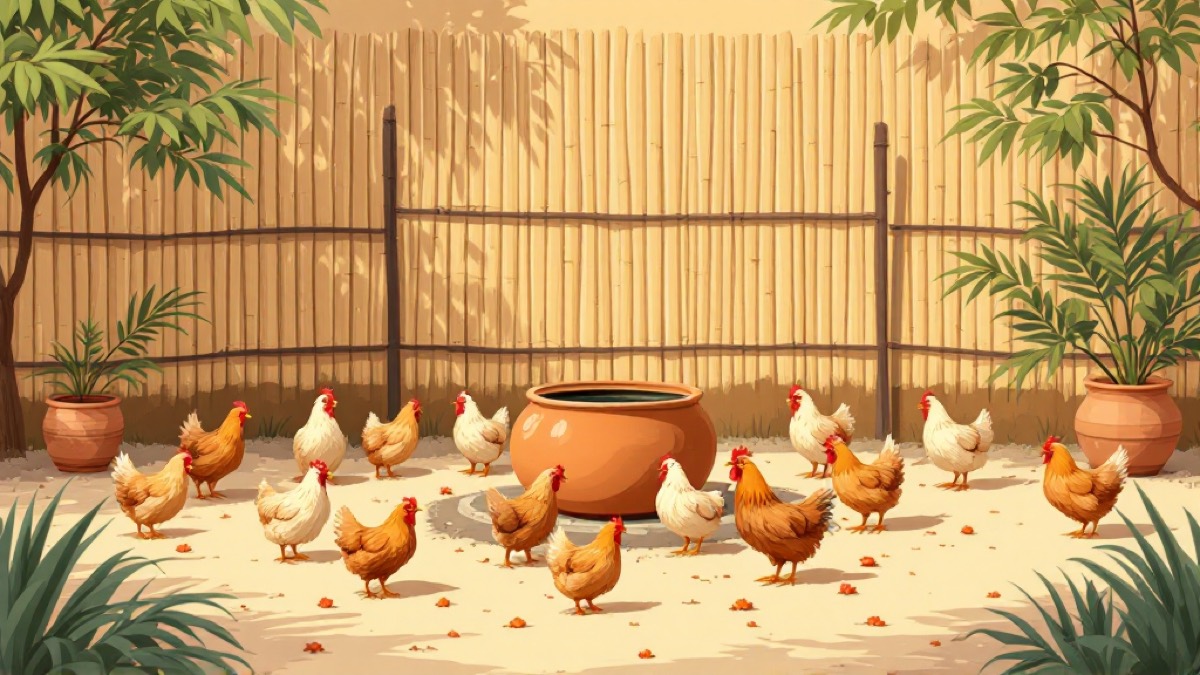
Hawks and Aerial Predators: The Daylight Problem
TL;DR: Birds of prey hunt in daylight and arrive from above, which makes fences irrelevant — cover is the answer, not walls. Roofed runs, netting, or natural cover the birds can reach quickly. Chicks, bantams and pale-plumaged birds are most at risk. A rooster gives the alarm, but that only helps if there is somewhere to go. Birds of prey are generally protected wildlife: deterrence and exclusion, not killing.
The one predator that makes free-ranging a genuine trade-off rather than a solved problem.
Why Fences Do Not Apply
Every other predator on this site is a perimeter problem — see chicken predators in the Philippines. You exclude them with mesh, buried edges, sealed gaps and a door you close at night.
A raptor arrives vertically. Fence height is irrelevant. And it hunts in daylight, when the birds are out and the house is open.
So the response is different in kind: overhead cover, and enough of it that a bird can reach it before something reaches the bird.
What Actually Works
Roof part of the run. The single most effective measure, and it solves three problems at once — aerial protection, shade in the heat, and dry ground in the wet season. See chicken run design, where roofing is the highest-value decision for exactly this reason.
Netting over an open run. Cheaper than roofing for a large area, and it needs supporting and checking after storms.
Natural cover. Trees, shrubs, and structures birds can get under quickly. This matters most for free-ranging flocks where roofing the whole range is impossible:
- Cover distributed across the range, not just at the house — a bird in the open needs somewhere close.
- Low shelters — a raised board, a bush, anything to break the line of sight.
- Avoid large open expanses with no refuge in the middle.
Supervised ranging. Birds out when someone is around, shut in otherwise. Unglamorous and effective.
Which Birds Are Most at Risk
- Chicks, always. Never brood or range chicks without overhead protection — see how to brood chicks.
- Bantams and Seramas — small enough for more species to take.
- Pale and white-plumaged birds, which are conspicuous against the ground. This is one practical reason colored slow-growing meat lines are used in outdoor systems while white commercial broilers are not.
- Silkies, which cannot fly and cannot get up out of reach.
- Birds with poor vision — Polish and other heavily crested breeds cannot see a threat coming.
The Rooster’s Role
A rooster watches for aerial threats and gives an alarm call, and the flock responds by taking cover. It is one of the genuine arguments for keeping one — see rooster vs hen and can hens lay eggs without a rooster.
The limit is obvious once stated: an alarm only helps if there is cover to run to. A rooster in a bare open run gives a warning nobody can act on.
On Killing Them
Birds of prey are generally protected wildlife. Deterrence and exclusion are the appropriate responses, and your local environment or agriculture office can advise on what applies where you are.
Practically, it is also the wrong solution: remove one bird from a territory and another moves in. The territory is what attracted it, and the flock is what makes the territory attractive. Cover is the durable answer.
Scare Devices
Reflective objects, moving deterrents and similar devices are widely used, and the consistent finding is that birds habituate to anything static.
If you use them:
- Move them regularly, or they become scenery.
- Treat them as a supplement to cover, not a replacement.
- Do not spend on them instead of roofing, which is the thing that actually works.
The Free-Range Trade-Off, Stated Plainly
Free-ranging gives you foraging, lower feed cost, birds doing what birds do, and the meat quality a native-chicken market pays for — see free-range native chicken farming.
It also exposes birds to aerial predators and dogs in a way a closed run does not. Predator loss is a real running cost of range-based systems, and our native chicken as a business guide counts it as such rather than treating it as bad luck.
That is not an argument against free range. It is an argument for budgeting the losses honestly and for putting cover across the range rather than only at the house.
The Honest Limits Here
That birds of prey hunt in daylight and take chicks and smaller birds, and that overhead cover rather than fencing is the effective response, is standard keeper experience. This guide does not identify species or quantify losses, because which raptors are present varies by area, and it makes no claim about the effectiveness of specific commercial deterrent products. Birds of prey are generally protected — check with your local environment or agriculture office before taking any action beyond exclusion and deterrence.
Related: chicken predators in the Philippines, chicken run design, free-range chicken house design, protecting chickens from dogs.
Frequently Asked Questions
Do hawks really take chickens?
Birds of prey take chicks and smaller birds, and larger raptors can take adult chickens. It is a daylight problem, unlike most predator pressure.
Why does fencing not help?
Because the attack comes from above. A fence of any height is irrelevant to something that arrives vertically, which is why cover rather than walls is the answer.
What actually protects a flock from above?
Overhead cover — a roofed run, netting, or natural cover such as trees and shrubs the birds can get under quickly.
Which birds are most at risk?
Chicks, bantams and other small breeds, and birds with white or pale plumage that are conspicuous against the ground.
Does a rooster help?
A rooster watches for aerial threats and gives an alarm call, and the flock takes cover in response. That only works if there is cover to take.
Is it legal to kill a hawk?
Birds of prey are generally protected wildlife. Deterrence and exclusion are the appropriate responses, and your local environment or agriculture office can advise.
Do scare devices work?
Reflective objects and similar deterrents are commonly used and birds habituate to anything static. Physical cover is what reliably works.