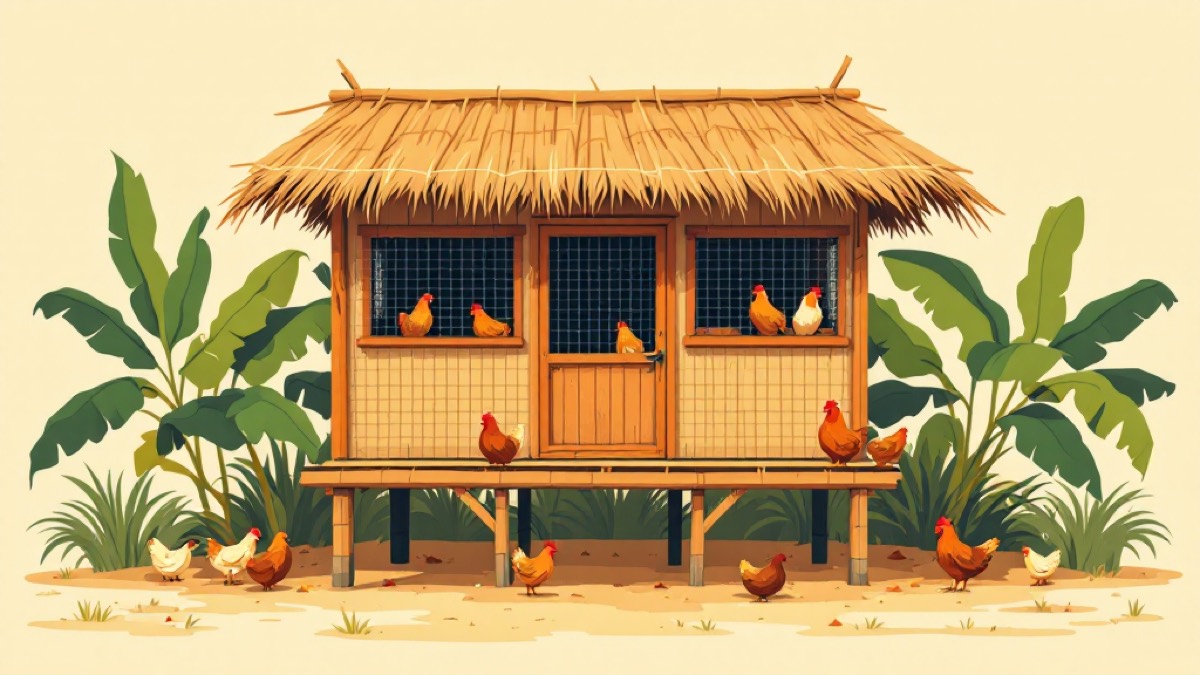
Free-Range Chicken House Design: Shelter, Not Confinement
TL;DR: In a free-range system the house is a night shelter and a nest site, not accommodation. What matters is roost length, nest boxes hens will actually use, a pop hole you can close, and dry ground around the entrance — not floor area. Shut birds in at night wherever predators are a risk, because that is when most free-range losses happen. Site it high and well-drained, because the ground at the door turns to mud faster than anywhere else.
Build for the two hours a day the birds are inside and awake, and for the night.
What Changes in a Free-Range System
The birds are outside for most of their active time — foraging, dust bathing, sheltering under whatever shade exists. The building has a narrower job:
| Job | What it needs |
|---|---|
| Night shelter | Secure, closable, predator-resistant |
| Roosting | Enough perch length for every bird |
| Laying | Nest boxes that hens prefer to the undergrowth |
| Wet-weather refuge | Dry standing room in rain |
| A place to shut birds in | For treatment, catching, or a storm |
Floor area matters less than in a confined system, because the birds are not standing in it all day. Roost length and nest provision matter more. See coop space per bird for the general figures and treat them as a floor rather than a target.
The Pop Hole Is the Security
A house that cannot be closed is not protection.
Most free-range losses happen at night or at dusk, when birds have gone in and predators come out. So:
- A pop hole you can shut, reliably, in the dark, in the rain, when you are tired.
- Sized for the birds, not for a dog or a large predator.
- Positioned where you can reach it without a walk across a wet field, or you will skip it on the nights it matters.
- Consider closing it after dark and opening at first light, which is when the birds want it anyway.
Our chicken predators in the Philippines guide covers what you are excluding, and snakes in the chicken coop and rats in the chicken coop cover the ones that get in through gaps rather than the door.
Nest Boxes Decide Whether You Find the Eggs
The most common free-range complaint is eggs laid in the undergrowth and never found.
The fix is nest boxes hens actually prefer:
- Dim and private. A curtain of sacking over the front, with an entry gap, is cheap and works.
- Inside the house, so eggs stay clean and dry.
- Enough of them that hens are not queuing and laying elsewhere.
- Soft, clean nest material, refreshed when soiled.
- Off the floor but easy to reach.
Collect frequently — see how to store chicken eggs and egg-eating hens, since a broken egg in a nest teaches a habit that is hard to stop.
Siting and the Mud Problem
The ground around the entrance is the part that fails first.
- High, well-drained ground. Not the low corner of the yard.
- Grade drainage away from the house before you need it.
- Hard standing or gravel at the entrance, where every bird walks every day.
- Shade within reach, natural or built — see keeping chickens cool in Philippine heat.
- Reachable by you, easily, twice a day.
Permanently wet ground at the door means dirty birds, dirty eggs, and the foot problems that follow — see bumblefoot and scaly leg mites.
Fixed or Mobile?
Mobile houses let birds work fresh ground, which spreads manure and reduces the parasite build-up that comes with birds using the same ground for years — the mechanism behind gapeworm and much of the worm burden in outdoor systems.
Against that: they are more work to build, more work to move, harder to make predator-proof, and they suit smaller flocks.
Fixed houses are simpler and stronger, and they need the ground managed instead — rotating range where you can, and avoiding permanently muddy, heavily used areas.
Either way, build it to survive weather: see typhoon-proof chicken coop, and note that a mobile house is easier to lose in a storm than a fixed one.
What Free-Range Does Not Remove
Worth stating, because the word suggests self-sufficiency it does not deliver:
- Feed. Foraging supplements a ration; it does not replace one during growth or lay — see free-range native chicken farming and native chicken feeding.
- Water. Clean, shaded, and refilled.
- Health management. Outdoor birds meet more parasites, not fewer.
- Biosecurity. Wild birds and neighbours’ flocks are a real exposure — see backyard flock biosecurity.
The Honest Limits Here
The design priorities described — night security, roost and nest provision over floor area, drainage at the entrance, and the trade-offs between fixed and mobile housing — are standard free-range practice. This guide gives no dimensions, roost lengths or nest box counts, because they depend on flock size and bird type; see coop space per bird for the general figures and adjust for your birds. Structural work should follow local building practice.
Related: free-range native chicken farming, poultry housing design, chicken predators, native chicken raising.
Frequently Asked Questions
What does a free-range chicken house need to do?
Provide secure shelter at night, somewhere dry to lay, shade and refuge during the day, and a defensible point of entry. The birds spend most of their active time outside it.
How big does the house need to be if birds are outside all day?
Enough that every bird can roost comfortably at night and lay without queuing. Roost length and nest box provision matter more than floor area in this system.
What is a pop hole?
The small opening birds use to come and go. It needs to be secure enough to close at night, since a house that cannot be shut is not protection against predators.
Should free-range birds be shut in at night?
Yes, wherever predators are a risk. Most losses in free-range systems happen at night or at dusk, and a house that closes is the single most effective protection.
Where should the house be sited?
On high, well-drained ground, with shade nearby, and positioned so you can reach it easily for shutting up and collecting eggs. Muddy ground around the entrance is a recurring problem.
Do free-range birds still need nest boxes?
Yes, and using them is what keeps eggs clean and findable. Without attractive nest boxes, hens lay in the undergrowth and you lose the eggs.
Can the house be moved?
Mobile houses let the birds work fresh ground and reduce parasite build-up. They are more work to build and to move, and they suit smaller flocks better.