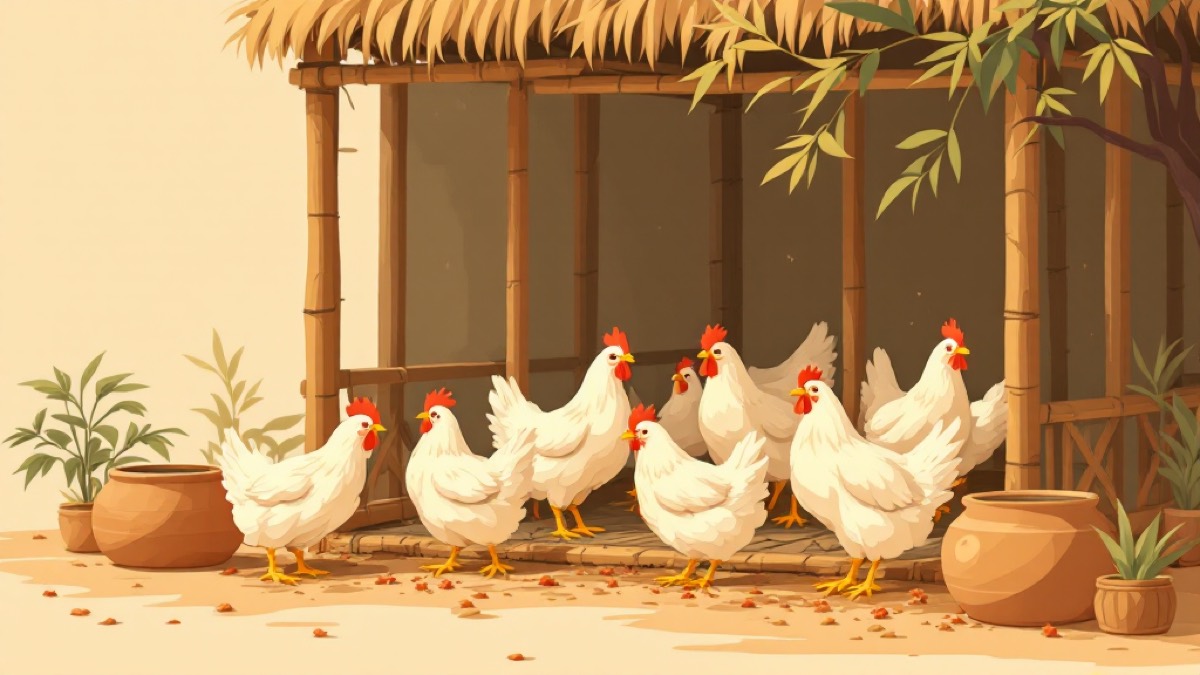
Cornish Cross: The Bird Behind the Modern Broiler
TL;DR: Cornish Cross is the shorthand for the fast commercial meat bird — Cornish over White Plymouth Rock foundation stock, selected for decades for growth rate and feed conversion, and sold today under company product names like Ross and Cobb. It reaches market weight in about six weeks and it is engineered for exactly that. Keep it past market age on free feeding and leg and heart problems follow. Decide the harvest date before the chicks arrive, or buy a different bird.
This is the most productive meat animal ever bred and the least flexible chicken you can own. Both facts come from the same place.
What Is a Cornish Cross?
A cross built on two foundations: the Cornish — a hard-feathered, wide-breasted, game-derived English breed with exceptional muscling — and the White Plymouth Rock, a hardy American dual-purpose breed with good growth and a white feather that dresses out cleanly.
That combination has been selected for growth rate, breast yield and feed conversion for generations. The modern commercial descendants are sold as branded products — Ross, Cobb and similar — rather than as “Cornish Cross,” but the name persists among smallholders and it points at the same lineage. Our broiler chicken breeds guide covers the current product landscape.
What Does Six-Week Growth Cost the Bird?
Its structural margin. That is not a moral point, it is a physiological one.
Muscle accumulates faster than the skeleton and the cardiovascular system are built to carry. The consequences are well documented in fast broiler stock kept beyond market age on unrestricted feed:
- Leg weakness and lameness — birds sitting more, walking less, reluctant to move.
- Foot pad and hock problems, made much worse by wet litter — see bumblefoot.
- Heart and circulatory failure, more likely in heat and at higher weights.
- Heat intolerance. A heavily muscled bird generates a lot of metabolic heat and sheds it poorly, which in Philippine conditions is the single biggest killer — see heat stress in chickens and broiler mortality causes.
The design assumption is that the bird is harvested before these become limiting. Remove that assumption and you have a welfare problem you created by accident.
The Rule: Decide the Harvest Date First
Before the chicks arrive, know when they are going.
That single decision drives everything else — how much feed to buy, how much space to build, when to arrange dressing or sale. Our when to harvest broiler chicken guide covers how to judge readiness, and broiler raising in the Philippines covers the full cycle.
If you want to hold birds longer than the standard cycle, the technique is deliberate feed restriction to slow growth — not simply feeding a broiler the way you would feed a laying hen. It requires management, and it is a different plan rather than an absence of one.
What Does It Need While It Is Growing?
Consistency, and more of everything than a native bird needs.
| Requirement | Why it matters more here |
|---|---|
| Formulated phased ration | The growth curve assumes it; see broiler chicken feeding program |
| Constant clean water | Feed intake tracks water intake; a dry drinker stalls growth immediately |
| Dry litter | Heavy birds sitting on wet litter get foot and hock lesions fast |
| Shade and airflow | Heat is the main mortality risk here — see coop ventilation |
| Space | Crowding compounds heat and litter problems; see coop space per bird |
| Brooding done properly | The first week sets the whole cycle — see how to brood chicks |
The economics come down to one number, and our broiler feed conversion ratio guide explains it: kilos of feed per kilo of weight gain. Everything above is really about protecting that number.
When Is It the Wrong Bird?
Often, for a Philippine backyard. Choose something else if:
- You want birds that live for years. Any dual-purpose, native or colored line.
- You want birds that forage. A Cornish Cross will stand at the feeder while a native bird works the yard — see free-range native chicken farming.
- Your feeding will be irregular. A fast broiler has no slack; a native bird does.
- You are selling into a market that pays for native meat. The premium is real, and a commercial broiler does not earn it — see broiler vs native vs layer.
- Your housing cannot control heat. In that case the bird will die before it is worth anything, and slower stock is simply the safer investment.
The Honest Limits Here
The Cornish and White Plymouth Rock foundation of commercial broiler genetics, the roughly six-week commercial cycle, and the leg, cardiovascular and heat-tolerance issues associated with keeping fast broilers past market age are documented in poultry science and industry practice. This guide gives no target weights, feed-conversion figures or Philippine prices, because those belong to a specific strain, ration and market — ask your supplier which strain you are buying and for the breeder’s own performance guide, then plan your cycle from that rather than from any blog post.
Next: broiler raising in the Philippines, broiler chicken feeding program, and broiler chicken breeds for the alternatives.
Frequently Asked Questions
What is a Cornish Cross chicken?
The common name for the fast-growing commercial meat bird built on Cornish and White Plymouth Rock foundation stock. Modern commercial versions are sold under company product names such as Ross and Cobb rather than as Cornish Cross.
How fast does a Cornish Cross grow?
Fast enough that commercial grow-out cycles run in roughly six weeks. That speed is the entire point of the bird and the source of all its management constraints.
Why do Cornish Cross birds have leg problems?
Because muscle mass accumulates faster than the skeleton and cardiovascular system comfortably support it. Leg weakness, lameness and heart and circulatory problems are well-documented consequences of keeping fast broilers past market age on unrestricted feed.
Can I keep a Cornish Cross as a laying hen or a pet?
It is not a fair plan for the bird. Fast broiler genetics are built for a short life at a target weight. If you want birds that live for years, choose dual-purpose, native or colored slow-growing stock instead.
Can I breed Cornish Cross birds myself?
Not practically. The birds you buy are grow-out stock produced from parent lines held by breeding companies, and they are not intended or suited to be bred from.
Do Cornish Cross birds forage?
Poorly. They are bred to eat from a feeder and grow, not to work a range. If you want a meat bird that forages, a colored slow-growing line or an upgraded native is the right choice.
Is a Cornish Cross suitable for Philippine backyard conditions?
Only if you can supply a consistent formulated ration, clean water, shade and ventilation, and you harvest on schedule. Without those, a slower, hardier bird will serve you better.