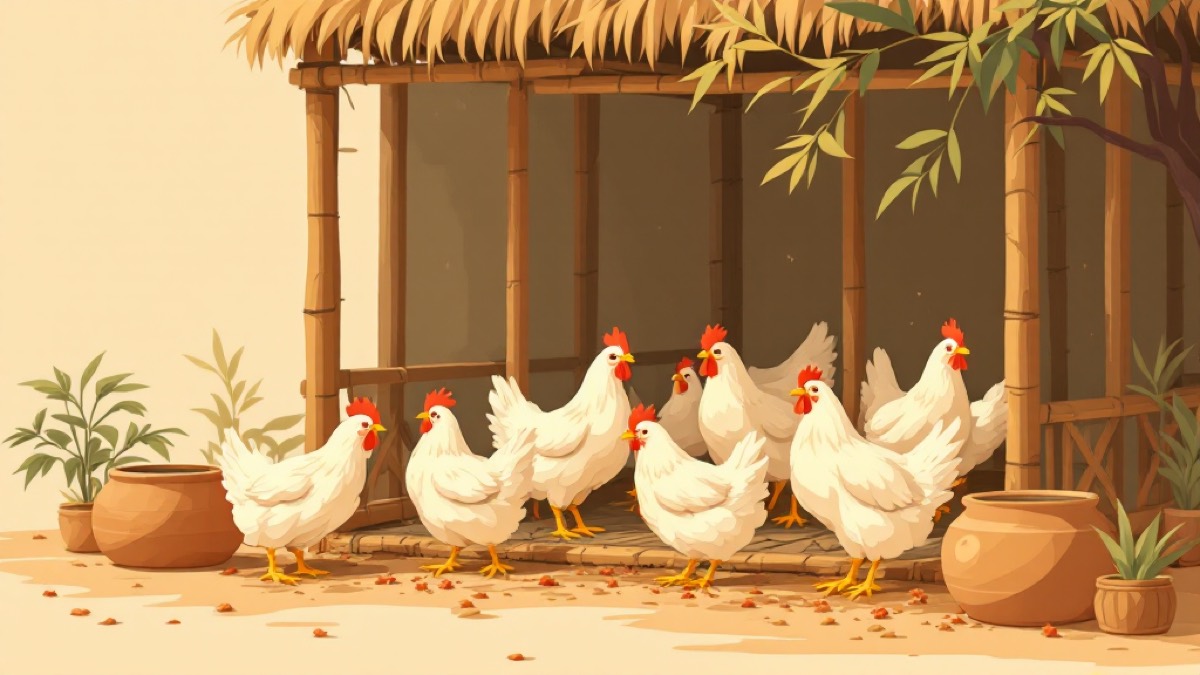
Broiler Raising in the Philippines: The Full Cycle
TL;DR: Raising broilers in the Philippines means a short, intense cycle — commonly 28-45 days from day-old chick to harvest weight, staged across starter, grower, and finisher feed. The bird’s rapid growth is the product of decades of selective breeding, and it comes with a real cost: broilers are more heat-sensitive, more feed-hungry, and less forgiving of crowded or dirty housing than a native chicken or layer at the same age. Get the housing and feeding basics right and the cycle is manageable at backyard scale.
Broilers are the chicken bred specifically to put on meat fast. Where a Philippine native chicken might take three to four months to reach a modest table weight, a broiler can reach a heavier weight in a little over a month. That speed is the entire point of the bird — and it’s also why broilers demand more precise management than almost any other chicken a backyard raiser keeps.
This guide covers what an actual broiler cycle involves: the timeline, the housing it needs, and the biological reason broilers grow the way they do. For the feed side specifically, see the broiler chicken feeding program; for how to judge whether your birds converted feed efficiently, see feed conversion ratio explained; and if you’re still deciding whether a broiler is even the right bird for your goal, broiler vs. native vs. layer lays out the honest trade-offs before you commit.
What Is a Broiler Chicken?
A broiler is a chicken raised specifically for meat, bred over decades to convert feed into muscle — especially breast muscle — far faster than an unselected or native bird. Modern broiler strains reach a market-ready weight in a fraction of the time a heritage or native breed needs at the same feed input, a difference driven by genetics rather than anything a grower does differently day to day.
That genetic difference is dramatic. Growth-rate studies comparing modern commercial strains to heritage lines found the modern bird’s breast muscle made up roughly 18% of total body mass at five weeks old, against about 9% for a heritage-line bird of the same age — the modern strain is putting on usable meat at roughly double the rate. That’s not a management outcome; it’s what generations of selective breeding for growth rate and feed efficiency actually changed in the bird.
The trade-off is that this speed comes packaged with fragility. A broiler’s frame, heart, and legs are supporting a growth rate its genetics push hard for, which is exactly why the housing and feeding sections below matter more for broilers than for a slower-growing bird.
How Long Does a Broiler Cycle Actually Take?
A broiler grow-out commonly runs 28-45 days from day-old chick to harvest, with the exact length depending on strain, target weight, and whether the grower is aiming for a smaller whole-bird market or a heavier cut-up bird. Fast commercial strains can reach market weight in as little as 32-35 days; slightly longer cycles in the 40-45 day range are also common in Philippine backyard and small commercial setups.
One Mindanao operation supported by the Southern Philippines Development Authority described running seven grow cycles a year, with roughly a 10-day cleaning and disinfection period built in between each flock before the next batch of chicks arrives — meaning the grow-out itself plus cleanout adds up to a repeatable cycle length across the year, not a one-off timeline. That same operation reported an average live weight of about 1.5 kg at harvest.
| Cycle stage | Typical duration |
|---|---|
| Grow-out (chick to harvest) | 28-45 days |
| Cleanout/disinfection between flocks | ~10 days |
| Full cycle-to-cycle turnaround | ~5-6 weeks (varies by setup) |
A cycle this short is the main reason broilers appeal to growers who want turnover — you find out relatively quickly whether a batch performed well, and you can run several cycles a year in the same space. It’s also why mistakes compound fast: there’s no long runway to correct a housing or feeding problem before the birds are already at slaughter age.
What Housing Does a Broiler Cycle Need?
Broilers need the same core housing principles as any chicken — dry flooring, real airflow, and enough floor space per bird — but enforced more strictly, because a fast-growing, densely stocked flock generates far more heat, moisture, and waste per square meter than a smaller number of slower-growing birds would in the same space. Our chicken coop size per bird guide covers baseline space allowances; broiler stocking, especially at commercial density, typically runs tighter than that baseline and leans even harder on ventilation to compensate.
Ventilation is the single most important housing factor for broilers. Philippine heat and humidity are already a heat-stress risk for any chicken, and broilers — bred for growth rather than heat tolerance — handle it worse than a native chicken or an adult layer at the same age. See chicken coop ventilation in Philippine heat and keeping chickens cool in Philippine heat for the specifics; both apply to broilers with less margin for error than to hardier birds.
Flooring and cleanliness matter more on a compressed timeline. A broiler batch spends its entire life on the same litter, and wet or dirty bedding at day 10 has three-plus weeks left to cause a problem before harvest. Follow the coop flooring, cleaning, and disinfecting guide between every batch — the SPDA-supported cycle above builds a full 10-day cleanout into its schedule specifically for this reason, not as an afterthought.
Biosecurity between batches is non-negotiable at any scale. A flock raised back-to-back in the same space without proper cleanout carries disease risk forward from one batch to the next. See backyard flock biosecurity for the baseline practices, whatever bird you’re raising.
Why Do Broilers Grow So Much Faster Than Other Chickens?
Broilers grow faster because of decades of selective breeding for growth rate and feed efficiency, not because of anything a grower does that a native-chicken or layer raiser doesn’t. Documented growth-rate comparisons found that in 1925 it took about 16 weeks to raise a chicken to roughly 1.1 kg; modern broiler strains now reach roughly 2.5 kg in under 7 weeks, with daily weight gain increasing more than threefold over that period. The muscle tissue itself is different — fast-growing strains show measurably higher expression of muscle-development genes than slower-growing breeds, which is the biological mechanism behind the breast-muscle difference cited earlier.
This matters for how you think about a broiler cycle. You are not managing a native chicken that happens to grow a bit faster — you are managing a bird whose biology is tuned for growth speed above almost everything else, including the leg strength and heat tolerance a slower-growing bird has more of. That’s the honest reason broiler housing and feeding both carry less margin for error than the equivalent setup for a native chicken.
What Does Broiler Feeding Look Like Across the Cycle?
Broiler feeding is staged by protein level as the bird grows — a high-protein starter feed for the first stretch, a grower feed as protein needs taper slightly, and a lower-protein finisher feed heading into harvest. The exact stage lengths compress or stretch depending on your cycle length; a 32-day cycle and a 45-day cycle don’t split into identical week-by-week stages. The full breakdown, including where a very short cycle can run on just two feed stages instead of three, is in the broiler chicken feeding program.
Feed is also the largest single cost in a broiler cycle, which is why growers track feed conversion ratio (FCR) — how much feed it took to produce a kilogram of live weight gain. A lower FCR means more efficient growth and a lower feed cost per kilo produced. See feed conversion ratio explained for the formula and what moves it, using your own feed and weight records rather than a number borrowed from somewhere else.
The Honest Limits Here
This guide describes the general shape of a broiler cycle — timeline, housing demands, and why the bird grows the way it does — using ranges and documented figures rather than a single fixed number, because actual cycle length, harvest weight, and performance vary by strain, season, stocking density, and how tightly a grower manages ventilation and cleanliness. Philippine day-old chick prices, feed prices, live-weight farmgate prices, and profit-per-bird figures change constantly and are not stated here — plug your own current local prices into the feed conversion ratio formula to get numbers that actually apply to your situation, rather than trusting a figure that was already out of date by the time it was published. This guide also doesn’t cover contract-growing arrangements with integrators, which run on terms set by the specific company and aren’t something a general guide can responsibly generalize.
Ready to plan the feeding side in detail? See the broiler chicken feeding program for the stage-by-stage breakdown, or step back and compare broilers against native chickens and layers before you commit to a bird type. Browse the full meat birds category for everything else in this track.
Frequently Asked Questions
How long does it take to raise a broiler chicken in the Philippines?
A full grow-out cycle commonly runs 28-45 days depending on the strain and target weight, with many backyard and small commercial setups harvesting around 32-42 days. Add a cleanout period between batches and a full cycle-to-cycle turnaround often lands closer to 5-6 weeks.
What weight do broilers reach at harvest?
A common commercial target is around 1.5 kg live weight, though the exact figure depends on the strain, the number of days raised, and the market a grower is selling into (whole bird vs. cut-up).
Do broilers need different housing than native chickens or layers?
The housing principles are the same — dry flooring, strong ventilation, and enough space per bird — but broilers need it enforced more strictly. Their rapid growth makes them far less tolerant of heat stress, ammonia buildup, and crowding than a native chicken or a mature layer.
Can I raise broilers in a small backyard?
Yes, on a small scale. A handful of broilers in a well-ventilated, appropriately sized pen is a realistic backyard project. Scaling up to dozens or hundreds of birds changes the equipment, ventilation, and biosecurity requirements substantially.
What is the biggest mistake first-time broiler raisers make?
Underestimating ventilation and space. Broilers generate far more heat and waste per bird than a native chicken at the same age because they are eating and growing so much faster, and a pen sized for native chickens is usually too crowded and too poorly ventilated for broilers.
Do broilers need a starter, grower, and finisher feed?
Yes, broiler feeding is staged by protein level as the bird grows — see our full broiler chicken feeding program for the stage-by-stage breakdown.
Is raising broilers more profitable than raising native chickens?
Broilers grow to market weight far faster, which changes the economics, but they also cost more per kilo of feed-efficient growth to start and are more fragile. See our broiler vs. native vs. layer comparison for the honest trade-offs rather than a single answer.