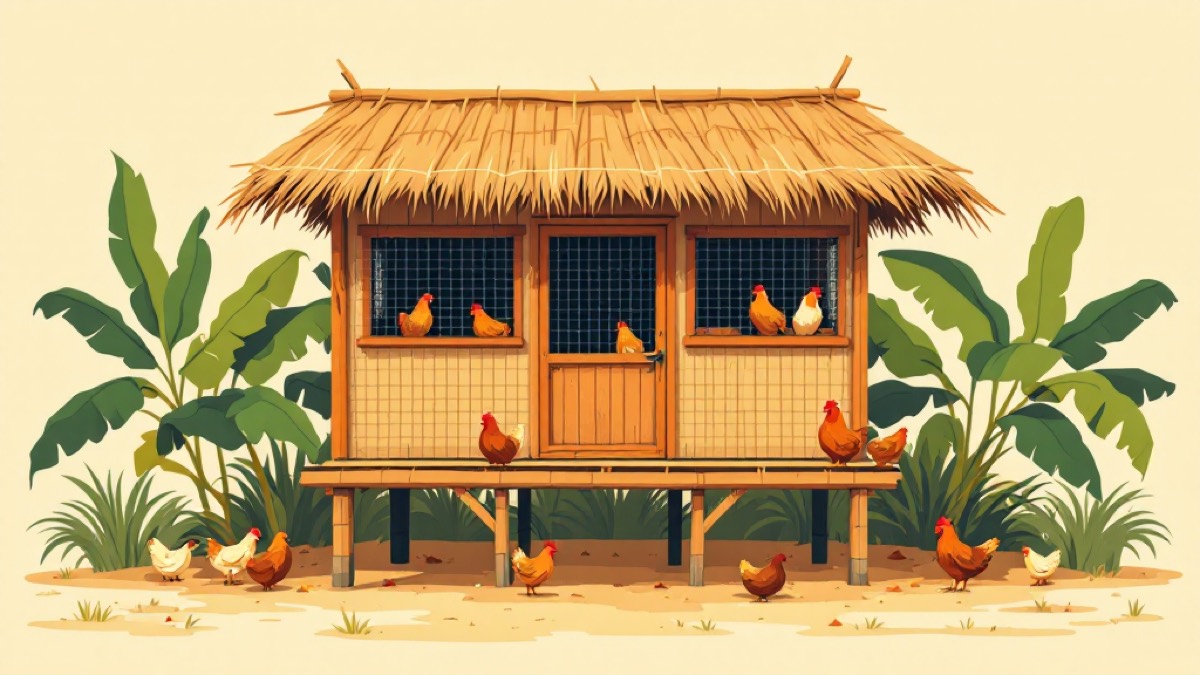
Chicken Coop Size Per Bird: Space Needed by Type
TL;DR: Space per bird depends on the system, not just the breed — enclosed floor housing runs roughly 2-4 sq ft (0.2-0.4 sqm) per standard bird, a gamefowl on a tie cord needs 2-3 sqm including cord radius, and a free-range native bird needs the least indoor space since it forages outside most of the day. There’s no single “chickens per square meter” number that’s honest across all three — the housing system decides the answer more than the bird does.
“How many chickens per square meter” sounds like it should have one clean answer. It doesn’t, and any guide that gives you a single number without asking what kind of bird and what kind of system you’re housing is skipping the part that actually matters. A gamefowl tied to a stake, a layer in a cage, and a native bird that free-ranges all day are solving completely different housing problems, and the honest space-per-bird figure is different for each.
This guide breaks down space requirements by system so you can plan a coop that fits your actual flock, not a generic average. For the structural side of building that coop, see chicken coop design for a Philippine backyard; for why cramped housing makes health problems worse, see chicken coop ventilation.
How Much Space Does a Chicken Need in General Floor Housing?
A commonly used baseline for enclosed coop floor space is roughly 2-4 square feet (about 0.2-0.4 square meters) per standard-sized bird, with the higher end of that range applying when birds don’t have separate outdoor run access.
That translates to roughly 2-5 birds per square meter of enclosed floor space — fewer if the coop is the flock’s entire living space, more if they range outside for part of the day and only use the coop for roosting and shelter. This is a general husbandry guideline, not a hard ceiling; actual comfortable density shifts with breed size, climate, and how much time birds actually spend inside versus out.
What changes the number:
- Breed size. Larger breeds need more floor space per bird than smaller or bantam breeds.
- Outdoor access. Birds with a run or free-range time during the day can be housed more densely at night than birds confined to the coop full-time.
- Climate. In a hot, humid climate, err toward the roomier end of any range — overcrowding raises heat and ammonia together, which is a bigger daily risk here than in a cooler climate.
How Much Space Does a Tied Gamefowl Need?
A gamefowl on a tie cord typically needs 2-3 square meters per bird, including the radius the cord allows it to move in — considerably more than a caged layer’s floor allotment, because the system’s purpose is different.
Tie-cord housing exists to keep birds separated so they don’t fight, not to pack birds efficiently for egg production. Stakes are spaced at minimum 3 meters apart center-to-center specifically so no two birds can reach each other. See gamefowl farm design and layout for the full spacing breakdown across tie cords, individual pens, and breeding pens — the figures there are sized specifically for gamefowl housing systems, not general backyard flocks.
How Much Space Does a Free-Range Native Chicken Need?
Free-range native birds need the least enclosed floor space of the three systems in this guide, because they spend most daylight hours outside foraging and only use housing for roosting at night and shelter from rain.
The coop itself mainly needs to comfortably fit the flock for overnight roosting — enough perch length for every bird to have a spot without crowding, and enough floor area that birds aren’t forced into direct contact while sheltering during a downpour. The land the birds forage on isn’t “coop space” in the stocking-density sense, but it matters just as much to the bird’s overall welfare and space needs as the structure itself.
Comparing the Three Systems
| System | Typical space per bird | Why it’s different |
|---|---|---|
| Enclosed floor housing (general/layer) | ~2-4 sq ft (0.2-0.4 sqm) per bird | Sized for stocking density and egg/meat production efficiency |
| Gamefowl tie cord | 2-3 sqm per bird, including cord radius | Sized to prevent fighting between birds, not production density |
| Free-range native, coop only | Less than either — coop is roosting/shelter only | Most of the bird’s day and space needs happen outside the coop |
| Cage system (commercial layer) | Considerably less floor area per bird than any of the above | Purpose-built for high-density egg production, not a backyard comparison point |
This table is deliberately not a single “right answer” — it’s meant to show why the question “how many chickens per square meter” needs a follow-up question first: what system, and what’s the bird doing with the rest of its day?
It’s also worth adjusting seasonally rather than treating any of these figures as fixed year-round. During the hottest stretches, birds naturally spread out more to lose heat, and a coop stocked at the dense end of its range in cool months can feel noticeably tighter in peak summer heat. If you’re planning close to the upper limit of any range above, build in enough spare floor space to loosen up during the hottest months rather than sizing the coop for the coolest ones.
What Happens When a Coop Is Overcrowded?
Overcrowding doesn’t cause one specific problem — it makes nearly every other housing problem worse, faster.
Ammonia and humidity build up quicker than ventilation can clear them in a crowded coop, which is part of why ventilation and space per bird are really the same underlying problem viewed from two angles. Crowding also increases pecking and stress-related aggression among birds competing for the same limited feeder, waterer, and roost space, and it accelerates how fast a disease moves through a flock once one bird is infected — less distance between birds means less time before exposure.
What’s the Honest Limit Here?
The figures in this guide are standard husbandry ranges, not measurements from a specific Philippine study, and they’re deliberately given as ranges rather than one precise number — real coops vary with breed, climate, and how much outdoor access birds actually get. If you’re stocking a coop near the dense end of any range, watch the birds rather than trusting the number alone: feather condition, pecking behavior, and how fast bedding fouls are better real-time signals than any published figure.
This guide also doesn’t cover chick and grow-out space requirements in detail — chicks need considerably less space per bird when very young, but that number climbs fast through the grow-out period, and a brooder sized correctly for day-olds is undersized within weeks without adjustment. That’s a separate topic from adult coop stocking density.
Space and ventilation solve different halves of the same crowding problem — read them together with chicken coop ventilation. Once the flock is sized to the space, regular cleaning is what keeps that density from turning into a disease problem. For a beginner’s starter-space rule of thumb before you’ve built anything yet, see how to raise gamefowl.
Raising a mixed flock — some tied gamefowl, some free-range native birds — and figuring out the space math yourself? That’s a common real-world setup this guide simplifies; let us know what worked in your yard.
Frequently Asked Questions
How many square feet does one chicken need in a coop?
A common baseline for enclosed floor housing is roughly 2-4 square feet (0.2-0.4 sqm) per bird for standard-sized breeds, with more room needed if the birds do not have separate outdoor access.
How many chickens can fit in one square meter?
Roughly 2-5 birds per square meter of floor space in enclosed housing, depending on breed size and whether the birds have outdoor run access — fewer birds per square meter if the coop is their only space, more if they range outside for part of the day.
Does a gamefowl need the same space as a layer hen?
No. A gamefowl on a tie cord typically gets 2-3 square meters including cord radius — far more than a caged layer's floor allotment — because tie-cord housing keeps birds separated to prevent fighting, not packed for egg production efficiency.
How much space does a free-range native chicken need?
Free-range native birds need the least enclosed floor space of the three systems, since they spend most of daylight hours outside foraging — the coop mainly needs to fit the flock comfortably for roosting at night and shelter during rain.
What happens if a coop is overcrowded?
Overcrowding raises ammonia and humidity faster than ventilation can clear it, increases pecking and stress-related aggression, and speeds up disease spread through a flock — it compounds nearly every other housing problem rather than causing one on its own.
How much space do chicks need compared to adult birds?
Considerably less per bird while very young, but chicks grow fast and need more space added incrementally through the grow-out period — a brooder that is correctly sized for day-old chicks is undersized within weeks if the flock is not moved to more space or thinned.
Should you use square footage or number of birds to plan a coop?
Plan from square footage first, then decide how many birds that space can responsibly hold — planning it the other way around (deciding on a bird count and hoping the space works out) is how overcrowding happens.