Gamefowl Vitamins & Supplements: What Breeders Use
TL;DR: The core supplements used by Philippine gamefowl breeders are B-complex (energy and recovery), Vitamin E (fertility and muscle recovery), Red Cell (an iron supplement formulated for horses and used off-label, only in the last 2-3 weeks before a fight), V22 (an all-in-one multi-vitamin), and electrolytes (daily during hot weather). This guide gives no dosages: amounts come from the product label and, for injectables and off-label products, from a veterinarian or agrivet. None of them fix a poor base diet, and over-supplementing fat-soluble vitamins (A, D, E, K) can become toxic — feed first, supplement second.
Walk into any gamefowl supply store in the Philippines and the sheer number of vitamins and supplements is overwhelming — B-complex, Red Cell, V22, iron tonics, liver protectors, electrolytes, amino acids, and many more. How do you know which ones you actually need and which are just wasted money?
In this guide, we’ll break down the commonly used gamefowl vitamins and supplements on the Philippine market — what each one does, when to use it, and which are truly essential vs nice-to-have.
Why Do Gamefowl Need Supplements?
Commercial feeds are generally complete in nutrition — but there are specific situations where supplementation is necessary and beneficial:
During stress periods. Stressful events — transfer, vaccination, molting, extreme weather — deplete vitamins and minerals. Supplementation during these times helps with recovery.
Conditioning phase. A gamefowl in conditioning is under physical stress similar to an athlete in training. It needs additional support for muscle recovery, energy production, and immune function.
Breeding season. Broodcocks and broodhens need extra nutrition for optimal fertility and egg production during the breeding season.
Recovery from illness. After sickness, the body is rebuilding — vitamins and minerals help with faster recovery.
The caveat: Supplements are not a replacement for proper feeding. If the base diet is wrong, no amount of supplements will fix it. Fix the feed first, then supplement.
Essential Vitamins for Gamefowl
B-Complex Vitamins
B-complex is arguably the most commonly used supplement in the Philippine gamefowl community — and for good reason.
What does it do? B vitamins (B1, B2, B3, B5, B6, B9, B12) are involved in energy metabolism, nervous system function, red blood cell production, and appetite regulation. Essentially, B-complex helps gamefowl convert food into energy efficiently.
When to use? During conditioning (for energy and stamina), after illness (for recovery), during stress periods, and regularly as a maintenance supplement.
Common products in the Philippines: Injectable B-complex is popular — typically administered subcutaneously or intramuscularly. Oral forms that can be mixed with water or feed are also available. Brands like B-Complex Forte and veterinary-grade B-complex solutions are widely available at vet supply stores.
Dosage guidance: Follow the product label, and ask a veterinarian or agrivet — particularly for injectable forms, where the route, site and technique matter as much as the amount. We deliberately give no figure here: concentrations differ between products, and the right amount depends on the bird’s weight and on what else it is already receiving. See B50 for gamefowl and B-complex for gamefowl.
Vitamin E
Vitamin E is critical for reproductive health and muscle function.
What does it do? It’s an antioxidant that protects cells from damage. In a gamefowl context, Vitamin E improves fertility (in both cocks and hens), promotes muscle recovery after conditioning, and supports immune function.
When to use? Before and during breeding season (for a fertility boost), during conditioning (for muscle recovery), and as a regular maintenance supplement.
Sources: Standalone Vitamin E capsules can be pierced and squeezed onto feed. Combined Vitamin E + Selenium supplements are also available — selenium complements Vitamin E for antioxidant function.
Vitamins A, D, and K
Vitamin A supports vision, immune function, and skin/feather health. Vitamin D is essential for calcium absorption and bone strength. Vitamin K aids blood clotting — particularly important for gamefowl exposed to injuries.
These are usually adequately supplied in commercial feeds, but supplementation is beneficial during stress, recovery, and breeding.
Popular Supplements on the Philippine Market
Red Cell (Iron Supplement)
Red Cell is one of the most popular gamefowl supplements in the Philippines — and one of the most searched on Google.
What does it do? Red Cell is primarily an iron supplement designed for blood building — increasing red blood cell count and improving oxygen-carrying capacity. Better oxygen delivery means better stamina and endurance.
When to use? During the conditioning phase — typically in the last 2-3 weeks before a fight. This is not an everyday supplement — it’s for conditioning only.
Dosage: We give no figure here, and this is the product where that matters most. Red Cell is formulated and dosed for horses, so its label dose refers to a horse — using it on a gamefowl is off-label, and the amount has to come from a veterinarian or agrivet rather than from an article or another keeper’s routine.
Warning: Iron is not like the B vitamins. Water-soluble vitamins are largely excreted in excess; iron is not, and excess iron can be harmful. Combine that with equine dosing on the label and a bird weighing a fraction of what the product was designed for, and this is the clearest case in the whole category for professional advice rather than estimation. Note also that a pale bird usually has a cause other than iron shortage — mites and worms drain a bird continuously, and iron does not stop the drain. Full detail in red cell for gamefowl.
V22 (Multi-Vitamin Supplement)
V22 is a popular multi-vitamin supplement in the Philippine gamefowl community.
What does it do? It’s a combination of multiple vitamins and amino acids designed for overall health support. Essentially an “all-in-one” supplement that covers multiple nutritional needs.
When to use? As a regular maintenance supplement (1-2 times per week), during recovery from illness, and during conditioning.
Availability: Widely available at gamefowl supply stores and vet shops in the Philippines.
Electrolytes
Electrolytes are critical — especially in the Philippine tropical climate.
What do they do? Electrolytes (sodium, potassium, chloride, magnesium) are involved in hydration, muscle function, and nerve transmission. In hot weather, gamefowl lose electrolytes through panting and are at risk of heat stress.
When to use? During hot weather (daily in the water), after stressful events (vaccination, transfer, illness), during conditioning, and after fights.
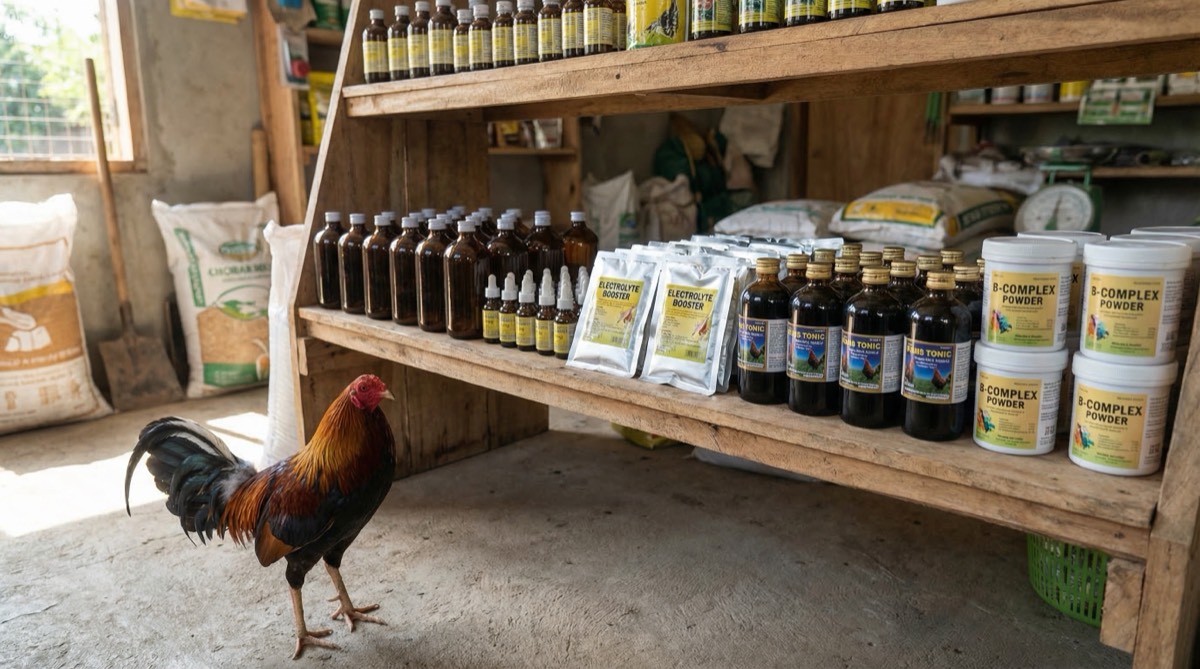
Common products: Vetracin, Gatorade for animals, or generic poultry electrolyte powder — available at most vet supply stores. You can also use ORS (Oral Rehydration Salts) from the pharmacy — cheaper but the same basic electrolytes.
Liver Tonics and Protectors
Liver tonics have become popular in gamefowl conditioning:
What do they do? The liver is the primary organ that filters toxins and metabolizes nutrients. Liver tonics are designed to support liver function — especially important when a gamefowl is on a heavy supplementation or medication regimen.
When to use? After medication courses (antibiotics, dewormers), during conditioning (if supplementation is heavy), and as periodic maintenance.
Common products: Liverin, Hepatovet, and other veterinary liver support products.
Amino Acid Supplements
Amino acids are the building blocks of protein — and of muscle.
What do they do? They support muscle growth, repair, and recovery. Particularly important during the conditioning phase when the gamefowl is under heavy physical training.
Common products: BCAA (Branched-Chain Amino Acids) supplements available at gamefowl supply stores. Feed-grade amino acid powders that can be mixed with feed are also available.
For a full conditioning-specific supplement stack, see our Conditioning Supplements Guide.
Supplementation Schedule: Practical Guide
How to read this section: what follows is a frequency framework — how often each type of supplement tends to feature at each stage. It is not a dosing schedule. The amount always comes from the product label and, for anything injectable or off-label, from a veterinarian or agrivet. Concentrations differ between brands, and several of these products overlap in what they contain, so read every label and total up what a bird is actually receiving.
Daily Maintenance (Non-Conditioning)
Gamefowl not in conditioning don’t need heavy supplementation. The basic maintenance routine is:
Clean water 24/7 — the most important “supplement.” Electrolytes in the water 2-3 times per week during hot weather. Multi-vitamin (V22 or similar) 1-2 times per week.
That’s it for maintenance. No need for a daily cocktail of supplements.
Conditioning Phase (14-21 Days Pre-Fight)
This is the phase where supplementation intensifies:
Weeks 1-2: B-complex (3 times per week), Vitamin E daily, electrolytes daily, liver tonic (every other day).
Last Week: Red Cell or iron supplement (as directed), B-complex (daily), electrolytes (daily), amino acids (daily).
Fight Day: Electrolytes and B-complex — minimal supplementation. The gamefowl should be at peak condition, not drugged up.
Breeding Season
Broodcocks: Vitamin E (daily), B-complex (3 times weekly), multi-vitamin (2 times weekly).
Broodhens: Calcium supplement (daily during laying), Vitamin E (daily), multi-vitamin (2 times weekly).
Post-Illness Recovery
First 3-5 days: Electrolytes daily, B-complex daily, multi-vitamin daily.
Next 5-7 days: Gradually reduce to maintenance levels.
Common Supplementation Mistakes
Over-supplementation. “More is better” is NOT true for vitamins. Excess vitamins — particularly fat-soluble vitamins (A, D, E, K) — can become toxic. Follow the recommended dosages.
Using human supplements. Human vitamin dosages are calibrated for a 60-80 kg person. A gamefowl weighs 2-3 kg. The overdosing risk is real. Use veterinary or poultry-specific supplements.
Neglecting the base diet. We’ll say it again: supplements are not a replacement for proper feeding. If feed quality is poor, no supplement will fix it.
Inconsistent supplementation. Vitamins and supplements work best when administration is consistent. A “once in a while” approach isn’t effective.
Mixing incompatible supplements. Not all supplements can be combined. Research or consult a vet before mixing multiple supplements in a single administration.
Guides to Individual Supplements
Each of these covers one commonly used product — what it is, what the ingredient does, and what to check on the label. None of them gives a dose, because dosing depends on the product concentration and the bird, and that decision belongs to your veterinarian or agrivet.
| Supplement | Guide |
|---|---|
| B50 (B-complex at 50 units) | B50 for gamefowl |
| B-complex generally | B-complex for gamefowl |
| Vitamin B12 | B12 for gamefowl |
| Multivitamins | Multivitamins for gamefowl |
| Bee pollen | Bee pollen for gamefowl |
| Red Cell (equine product, off-label) | Red cell for gamefowl |
| Electrolytes | Electrolytes for chickens |
The overlap warning is worth repeating here: B vitamins appear in B-complex products, multivitamins, tonics and the ration itself. A keeper running three products may be giving several doses of the same vitamins without intending to. Read every label and total it up.
Where to Buy Gamefowl Supplements in the Philippines
Veterinary supply stores — the primary source. Available in most towns and cities.
Gamefowl specialty shops — stores specifically focused on gamefowl supplies. Common in Pampanga, Bulacan, Cebu, and other sabong-heavy areas.
Online stores — Shopee and Lazada have many gamefowl supplement sellers. Check reviews and ratings before buying.
Agri-supply centers — larger agricultural supply stores stock poultry vitamins and supplements.
Tip: Only buy supplements with clear labeling — brand name, ingredients, dosage instructions, and expiration date. Avoid unbranded or suspicious products.
Conclusion
Vitamins and supplements are valuable tools in gamefowl management — but they’re just tools, not magic solutions. The foundation is always proper nutrition through quality feeds, and supplements are additional support for specific situations.
Invest in the essentials (B-complex, Vitamin E, electrolytes), use conditioning supplements (Red Cell, amino acids) only when needed, and don’t over-supplement.
For a more detailed conditioning program that includes a supplementation schedule, read our 21-Day Conditioning Guide.
For what’s actually verified in specific vitamin and supplement products sold in the Philippines, active ingredients, forms, and manufacturer label claims, see the medicine directory.
Looking for well-supplemented, healthy gamefowl from trusted breeders? See our guide on finding and vetting gamefowl breeders for how to check a seller before you buy.
Frequently Asked Questions
What is the most commonly used gamefowl supplement in the Philippines?
B-complex is the most widely used — it's given during conditioning, after illness, during stress periods, and as a regular maintenance supplement.
When should you give Red Cell to gamefowl?
Only during the conditioning phase, typically the last 2-3 weeks before a fight. It's not an everyday maintenance supplement.
What does V22 do for gamefowl?
It's a multi-vitamin and amino acid combination used as general maintenance (1-2 times weekly), during recovery from illness, and during conditioning.
Do gamefowl need electrolytes every day?
Only during hot weather, after stressful events like transfer or vaccination, during conditioning, and after fights — not as a daily baseline outside those situations.
Can you give gamefowl human vitamin supplements?
No. Human dosages are calibrated for a 60-80 kg person, while a gamefowl weighs 2-3 kg, so the overdosing risk is real. Use veterinary or poultry-specific supplements instead.
What happens if you over-supplement gamefowl?
Excess vitamins — particularly fat-soluble ones (A, D, E, K) — can become toxic. Follow the recommended dosages rather than assuming more is better.
Can supplements replace a poor gamefowl diet?
No. If the base feed is wrong, no amount of supplementation will fix it — fix the feed first, then supplement.
Where can you buy gamefowl supplements in the Philippines?
Veterinary supply stores, gamefowl specialty shops (common in Pampanga, Bulacan, and Cebu), online sellers on Shopee and Lazada, and agri-supply centers.