3-Phase Gamefowl Conditioning Supplement Guide
TL;DR: Gamefowl conditioning supplementation runs in 3 phases — pre-conditioning cleanup (7-14 days), active conditioning (day 1-14/17), and peaking/keep (last 3-5 days) — with B-Complex vitamins as the cornerstone supplement throughout for energy metabolism. Iron (Red Cell) should start on Day 7-10 of conditioning, 3x/week, then stop by the taper phase, since red blood cells need days to build up. Electrolytes go in the water daily during conditioning and on fight day, but nothing new should ever be tried for the first time on fight day. Over-supplementation is dangerous — a 2-3 kg gamefowl needs poultry-specific doses, not human-scale amounts.
Conditioning supplements are the fine-tuning tools of gamefowl preparation. If nutrition is the foundation and exercise is the structure, supplements are the finishing touches that optimize performance for peak output on fight day.
But many breeders get the approach to supplementation wrong — either too much, wrong timing, or the wrong product entirely. In this guide, we’ll clarify what to use, when to use it, and how to use it — based on what actually works and what successful Filipino handlers use.
The Conditioning Timeline and Supplement Phases
Conditioning is typically divided into 3 phases, and supplementation adapts to each one:
Pre-Conditioning Phase (7-14 Days Before Conditioning Starts)
This is the preparation period — not formal conditioning yet, but setting up the body for the intensive training ahead.
Goal: Clean the system, rebuild nutritional stores, and ensure the gamefowl is healthy before intensive conditioning begins.
Key supplements in this phase:
Liver tonic/protector is used for 3-5 days to clean and prep the liver for the upcoming heavy supplement load. The liver processes all supplements and medications — it needs to be healthy.
Deworming medication is ideally done 2-3 weeks before fight day. This clears internal parasites that steal nutrients.
Bacterial flushing — after deworming, some handlers do a short antibiotic course (under vet guidance) to clear any possible bacterial load.
Multivitamins — general vitamin supplementation to rebuild nutritional stores. V22 or similar products, daily for this phase.
Active Conditioning Phase (Day 1-14 or Day 1-17)
This is the main conditioning period — intensive exercise, controlled diet, and strategic supplementation.
Goal: Build muscle, improve cardiovascular fitness, and optimize energy systems.
Key supplements in this phase:
B-Complex Vitamins. The cornerstone supplement of the conditioning phase. B vitamins are directly involved in energy metabolism — converting food into usable energy. Without adequate B vitamins, gamefowl can’t sustain intensive exercise.
Administration: 3 times per week (Monday, Wednesday, Friday) during active conditioning. Both injectable and oral forms are available — injectable is faster-acting, but oral is more convenient.
Vitamin E. For muscle protection and recovery. Intensive exercise causes oxidative stress on muscles — Vitamin E as an antioxidant protects muscle cells from damage and promotes faster recovery between training sessions.
Administration: Daily during conditioning, either as an oral capsule (pierce and squeeze onto feed) or as part of a multi-vitamin supplement.
Iron Supplement (Red Cell). For blood building — increasing red blood cell count and improving oxygen delivery to muscles. Better oxygen delivery means better endurance and stamina.
Administration: Start on Day 7-10 of conditioning, 3 times per week. Timing is important — iron needs several days to be incorporated into red blood cells, so it’s not effective if given only at the last minute.
Dosage: Typically 1-3 mL of equine Red Cell per gamefowl, mixed into feed. Follow product recommendations and never overdose.
Electrolytes. For hydration and mineral balance — especially critical in Philippine heat. Dehydration during training reduces performance and increases injury risk.
Administration: Daily in drinking water during conditioning.
Amino Acid Supplements. For muscle repair and building — BCAAs (Branched-Chain Amino Acids) are particularly beneficial during intensive training.
Administration: Daily, mixed into feed. Available at gamefowl supply stores.
Peaking Phase / Keep (Last 3-5 Days Before Fight)
This is the final phase — the goal is peak physical readiness on fight day.
Goal: Taper exercise, maximize energy stores, and fine-tune the body for optimal performance.
Key supplements in this phase:
B-Complex — continued. Daily administration during the keep phase. Energy metabolism support is critical through fight day.
Carbohydrate loading. Not a supplement per se, but shifting to a higher carbohydrate diet in the last 2-3 days is important to top up glycogen stores (energy reserves in the muscles).
Electrolytes — continued. Daily. Proper hydration going into fight day is critical.
Reduce or stop iron supplementation. By this phase, the red blood cells built during conditioning are already in circulation. Additional iron isn’t needed in the last few days.
Light multi-vitamin. Maintenance dose only — no heavy supplementation. The body should be in peak state, not overloaded.
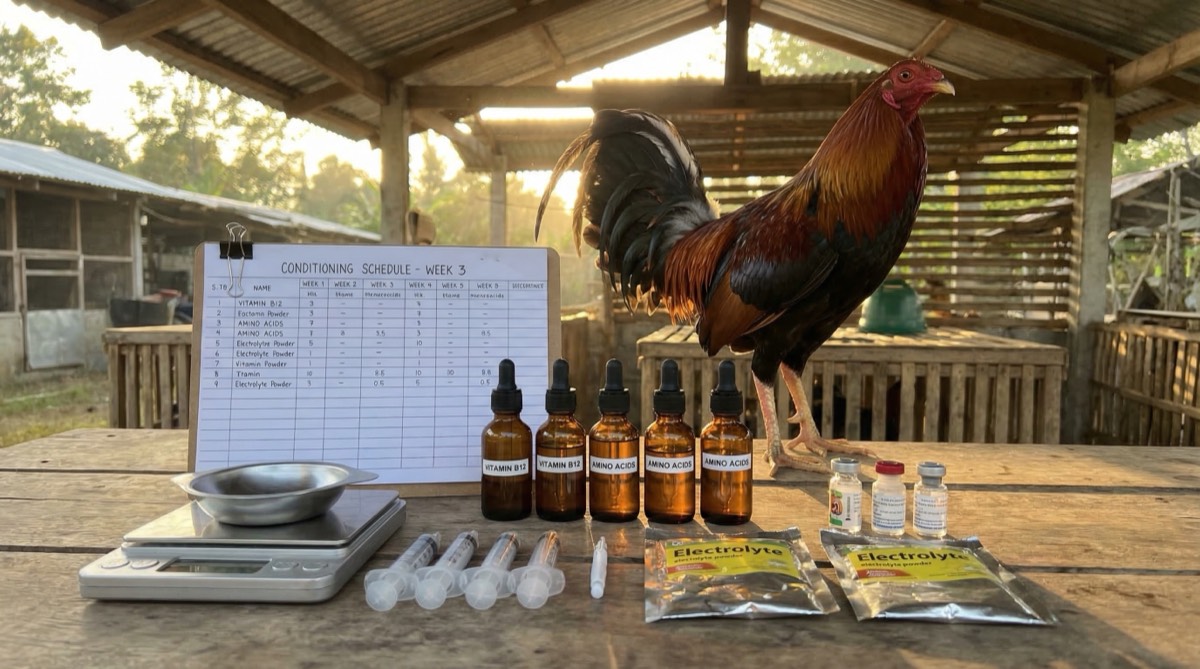
Fight Day Supplementation
Fight day supplementation is minimal and focused:
Morning of fight: Light feeding (small amount, high energy). B-complex (oral). Electrolytes in water.
1-2 hours before fight: Small amount of electrolyte water. Some handlers give a small dose of B12 (for energy) — but not mandatory.
Immediately before fight: Nothing heavy. The gamefowl should feel light, energized, and alert — not full, drugged, or over-supplemented.
Key principle: Fight day is not the day to experiment with a new supplement. Everything used on fight day should have been used during conditioning — no surprises.
Post-Fight Recovery Supplementation
After the fight, the gamefowl needs recovery support:
Electrolytes — immediate rehydration.
B-Complex — for energy recovery.
Wound care — antiseptic treatment for any injuries (not a supplement, but essential post-fight).
Light feeding — small amount of easily digestible food.
Liver tonic — after 1-2 days, to support the liver that processed all the conditioning supplements.
Complete Supplement Schedule (21-Day Conditioning Example)
Here’s a sample schedule you can adapt from our 21-Day Gamefowl Conditioning Program:
Day 1-3 (Pre-Conditioning Cleanup): Liver tonic daily. Multi-vitamin daily. Electrolytes in water.
Day 4-7 (Early Conditioning): B-Complex 3x/week. Vitamin E daily. Electrolytes daily. Amino acids daily.
Day 8-14 (Peak Conditioning): B-Complex 3x/week. Vitamin E daily. Red Cell/Iron 3x/week (start here). Electrolytes daily. Amino acids daily.
Day 15-18 (Taper Phase): B-Complex daily. Vitamin E daily. Electrolytes daily. Stop iron supplementation.
Day 19-21 (Keep/Peaking): B-Complex daily. Electrolytes daily. Light multi-vitamin. Carb loading in diet.
Fight Day: B-Complex (morning). Electrolytes. That’s it.
Common Mistakes
Mistake 1: Over-Supplementation
The “more is better” mentality is dangerous. Excess vitamins and minerals are toxic — iron overdose damages the liver, excess Vitamin A causes toxicity symptoms. Stick to recommended dosages.
Mistake 2: Starting Supplements Too Late
Iron supplementation started 2 days before the fight is useless — the body needs time to produce new red blood cells. Start conditioning supplements early enough for them to take effect.
Mistake 3: Inconsistent Administration
Skipping doses or irregular scheduling reduces effectiveness. Supplements work best when consistent — same time, same dosage, regular schedule.
Mistake 4: Using Human Supplements at Human Doses
A gamefowl weighs 2-3 kg — a human weighs 60-80 kg. A human-dose supplement is potentially lethal for gamefowl. Always use veterinary or poultry-specific products, and adjust dosages for gamefowl body weight.
Mistake 5: Neglecting the Base Diet
Worth repeating: supplements are SUPPLEMENTS, not replacements. If the base diet is poor — low quality feed, inadequate protein, insufficient water — no amount of supplements will compensate.
Mistake 6: Experimenting on Fight Day
Don’t try a new supplement for the first time on fight day. Unexpected reactions — digestive upset, allergic reaction, behavioral changes — are possible. All supplements should be tested during conditioning first.
Where to Buy Quality Supplements
Veterinary supply stores — the primary source for veterinary-grade supplements. More reliable quality.
Gamefowl specialty shops — stores focused on gamefowl products. Common in sabong-heavy areas.
Online (Shopee/Lazada) — convenient, but verify seller reputation. Counterfeit supplements do exist.
Direct from breeders — some experienced breeders sell their recommended supplement kits. A good option if you trust the source.
Tip: Buy supplements with clear labeling — ingredients, dosage instructions, manufacturing date, and expiration date. Avoid unbranded or repackaged products without proper labeling.
Conclusion
Conditioning supplements are a valuable part of gamefowl preparation — but they’re not the magic ingredient. Supplements are amplifiers — they amplify what’s already there. Good genetics + proper nutrition + structured exercise + strategic supplementation = peak performance.
Don’t obsess over supplements while neglecting the fundamentals. Fix the foundation first, then fine-tune with supplements.
For a complete conditioning program that includes exercise, feeding, and supplementation, read our 21-Day Gamefowl Conditioning Program.
For what’s actually verified in the conditioning products sold in the Philippines, active ingredients, forms, and manufacturer label claims, see the medicine directory.
Looking for conditioned, battle-ready gamefowl? See our guide on finding and vetting gamefowl breeders for available sources.
Frequently Asked Questions
How many phases are there in gamefowl conditioning supplementation?
Three: pre-conditioning cleanup (7-14 days before), active conditioning (day 1-14 or 1-17), and the peaking/keep phase (last 3-5 days before the fight).
When should you start iron (Red Cell) supplementation?
On Day 7-10 of active conditioning, 3 times per week, then stop by the taper phase since red blood cells need several days to build up.
What's the cornerstone supplement during active conditioning?
B-Complex vitamins — they're directly involved in energy metabolism, converting food into usable energy for intensive exercise.
Should you give a gamefowl a new supplement on fight day?
No. Fight day is not the day to experiment — everything used on fight day should already have been tested during conditioning.
How much Red Cell (iron) should you give a gamefowl?
Typically 1-3 mL of equine Red Cell per gamefowl, mixed into feed — follow product recommendations and never overdose.
What supplements does a gamefowl need for post-fight recovery?
Electrolytes for rehydration, B-Complex for energy recovery, wound care for injuries, light feeding, and a liver tonic after 1-2 days.
Can you use human supplements for gamefowl?
No. A gamefowl weighs 2-3 kg versus 60-80 kg for a human — always use veterinary or poultry-specific products at doses adjusted for gamefowl body weight.
Where should you buy gamefowl conditioning supplements?
Veterinary supply stores, gamefowl specialty shops, reputable online sellers (verify the seller), or trusted breeders who sell their own supplement kits.