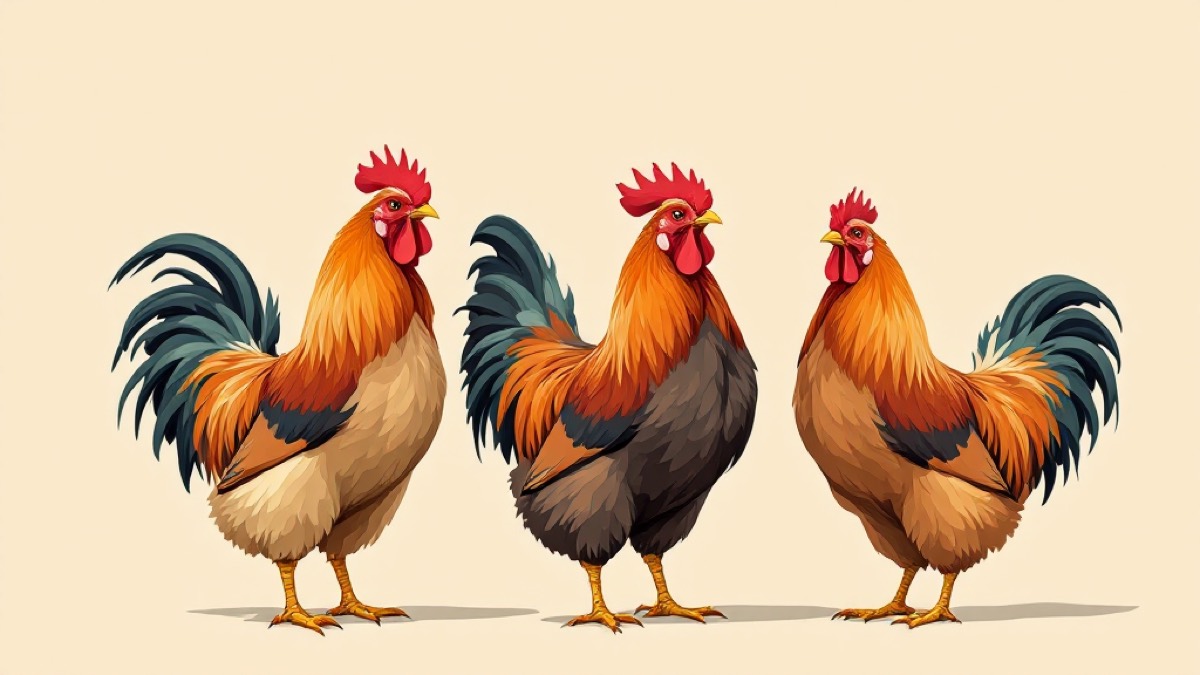
How to Identify Gamefowl Bloodlines: A Step-by-Step Guide
TL;DR: Identify a gamefowl’s bloodline by cross-referencing physical traits (feather color, leg color, comb type, body station) with pedigree records — no single trait is proof on its own. Feather color, leg color, and comb type are your first visual cues; pedigree documentation tracing 3-5 generations back is the most reliable proof. This guide does not use fighting style as an identification marker, because a style claim tied to a family name can’t be tested against a live bird the way plumage or leg color can, and individual birds within a bloodline vary more than the descriptions suggest. If there’s no pedigree available, describe the bird by its physical traits and be upfront with buyers instead of claiming it’s pure.
One of the most common questions from beginners in gamefowl breeding: “How do I know what bloodline my gamefowl is?”
It’s an important question. If you don’t know your gamefowl’s bloodline, you can’t plan your breeding program properly. Your crosses will be off, you won’t be able to predict chick outcomes, and you won’t be able to price correctly for buyers.
In this article, we’ll walk you through the step-by-step process of identifying gamefowl bloodlines — from observing physical characteristics to using pedigree records. For a full rundown of each bloodline’s traits and history, see our guide to the best gamefowl bloodlines in the Philippines.
Why Does Knowing the Bloodline Matter?
Knowing your gamefowl’s bloodline matters for three things: breeding decisions, honest selling, and record-keeping.
For breeding decisions. Every bloodline carries its own documented ancestry and physical type. Kelso is known for yellow legs and a medium station. Hatch is known for green (willow) legs and a compact, low-station build. Sweater is a high-station bloodline, usually with a pea comb. When you know your stock’s bloodline, you can pick the right cross to maintain the physical traits and lineage you’re breeding for.
For honest selling. If you’re selling gamefowl and you’re not sure of the bloodline, you shouldn’t claim it’s pure. Many buyers — especially experienced breeders — will notice right away if your claims don’t match the bird’s actual physical traits.
For record-keeping. Solid pedigree records are the backbone of any breeding program. Without accurate bloodline information, you’re building a house without a foundation.
Step 1: Examine the Physical Characteristics
The most basic way to identify a bloodline is through physical observation. Each bloodline has a distinct combination of traits.
Feather Color and Pattern
Feather color is the first visual cue, but on its own it isn’t enough to identify a bloodline — you need to cross-reference it with other traits.
| Feather Color/Pattern | Common In |
|---|---|
| Red | Kelso, Hatch, and many other bloodlines |
| Dark red to mahogany | Claret (White Clarets run lighter with reddish tints) |
| Black-breasted red | Roundhead and Grey crosses (black/dark breast, red-to-orange saddle and hackle) |
| Spangled or pyle | Sweater and its crosses (mixed white and red feathers) |
| Grey | Grey bloodlines and their crosses |
Leg Color
Leg color is one of the most reliable identification markers:
| Leg Color | Common In |
|---|---|
| Yellow | Kelso, Sweater, and many American-bred bloodlines |
| Green (willow) | Hatch, Roundhead, and Grey bloodlines |
| White | Asil and some Oriental breeds |
| Dark or slate | Grey bloodlines and some Claret strains |
Comb Type
Straight comb (single comb) — The most common. Kelso, Hatch, and most American gamefowl have straight combs.
Pea comb — Smaller and more compact. Often seen in Asil, Oriental crosses, and some lines of Roundhead and Sweater.
Body Type and Station
High station — Tall build, long legs, often seen in Sweater and Asil-influenced bloodlines.
Medium station — Balanced height and body. Kelso and Roundhead are typical medium-station gamefowl.
Low station — Short build and compact body. Hatch and Albany are well-known low to medium-station bloodlines.
Step 2: On “Fighting Style”
Fighting style is the trait most buyers ask about when trying to pin down a bloodline, so it deserves a direct answer rather than a silent skip: this guide does not use fighting style as an identification marker, for any bloodline.
The reasons:
- There is no test you can run on a live bird. Feather color, leg color, and comb type are visible in the pen right now. A style claim attached to a family name is not — it’s a description of what someone says the bloodline does, not something you can check against the bird in front of you.
- Variation within a bloodline exceeds the differences the descriptions claim between bloodlines. Individual birds from the same hatch differ in temperament and behavior. A description broad enough to fit a whole family is broad enough to fit almost anything.
- Conditioning, feeding, health, and handling shape behavior at least as much as ancestry does — see 21-day gamefowl conditioning and gamefowl feeding guide. Attributing behavior to bloodline alone skips over everything else that produced it.
- The descriptions are commercially useful to sellers, which is a reason to be careful with them rather than a reason to use them as an identification method.
What you can rely on instead is Step 1’s physical markers, cross-referenced with each other and backed by Step 3’s pedigree records. That combination is checkable. A behavioral description is not, and this guide won’t ask you to identify a bloodline by one.
Step 3: Check the Pedigree Records
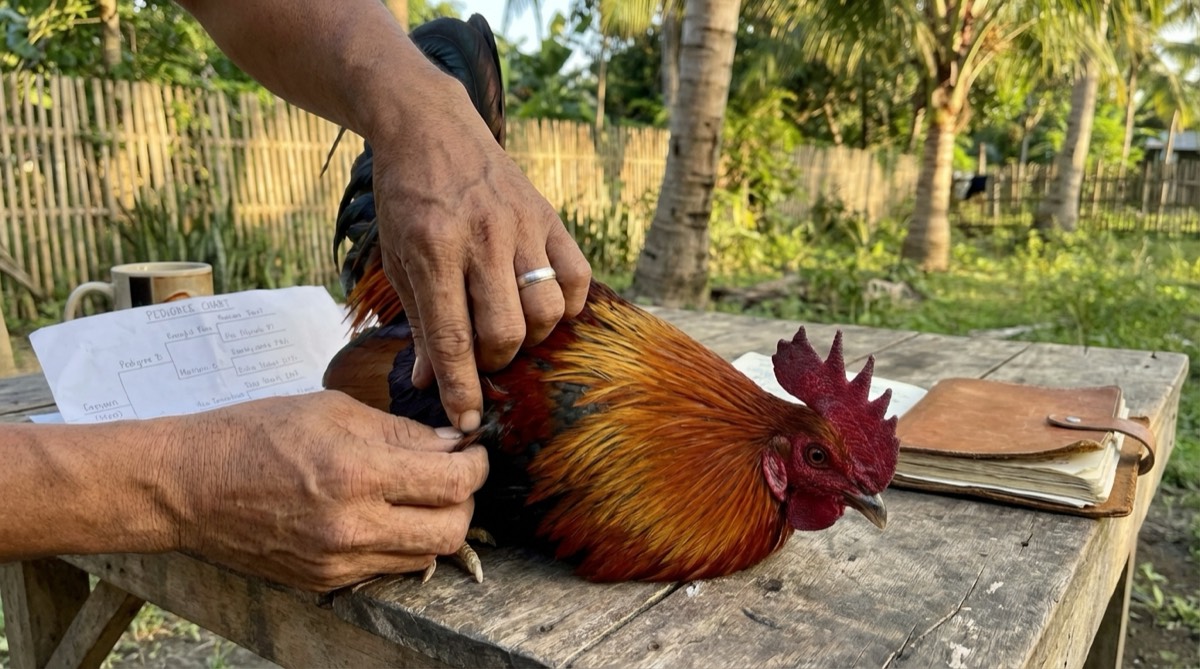
The most reliable method of bloodline identification is through pedigree documentation. This is the paper trail of your gamefowl’s lineage.
What’s included in a pedigree record?
A complete pedigree record includes:
Sire (father) and Dam (mother) information — Including their bloodline and physical description.
Multi-generation lineage — Ideally, 3-5 generations back. The more generations you can trace, the more confident you can be in bloodline purity.
Breeder information — Who bred the bird? Reputable breeders have consistent records and are known for specific bloodlines.
Hatch date and band number — For tracking and verification purposes.
What if there are no pedigree records?
If your bird has no pedigree — common with gamefowl bought from informal sellers or inherited from acquaintances — you have a few options:
Ask the source. If still available, talk to the person you bought the bird from. Sometimes they have a verbal history about the bloodline, even without written records.
Consult experienced breeders. Bring your bird to senior breeders who’ve been in the industry a long time. Many of them can identify a bloodline or at least narrow down the possibilities based on physical traits.
Accept the uncertainty. If there’s truly no way to verify the bloodline, don’t claim it’s pure. You can describe it based on physical characteristics — for example, “Red, yellow-legged, medium station, straight comb” — and be honest with buyers.
Step 4: Cross-Reference Multiple Traits
A single trait isn’t enough to conclude a bloodline — you need to look at the combination of multiple characteristics. The more traits that align with a specific bloodline, the more confident you can be in the identification.
| Feathers | Legs | Station | Likely Bloodline |
|---|---|---|---|
| Red | Yellow | Medium, straight comb | Kelso or Kelso cross |
| Red | Green | Compact body | Hatch or Hatch cross |
| Spangled/pyle | Yellow | High, pea comb | Sweater or Sweater cross |
| Black-breasted red | Green | Medium | Roundhead or Roundhead cross |
| Dark red/mahogany | Yellow to green | Medium | Claret |
Every column here is something you can see standing in front of the bird, which is the whole point. “Likely bloodline” is a starting hypothesis, not a conclusion — confirm it against Step 3’s pedigree records before treating it as settled.
There is deliberately no temperament or behaviour column. Temperament varies more between individual birds than between families, so a table that assigned a disposition to each bloodline would be inventing a pattern rather than recording one. Observe how the specific bird in front of you handles, and let that inform your decision about that bird. It is not evidence of its ancestry.
Step 5: Use a Breeding Chart for Documentation
Once you’ve identified your stock’s bloodline, document it properly in a breeding chart. Here’s a basic template:
For each gamefowl on your farm, record the following:
The identification — band number, name, or other unique identifier. The bloodline — whether pure or cross, write the specific combination. The physical traits — feather color, leg color, comb type, station, weight. The parents — who are the sire and dam, and what are their bloodlines. The hatch date — for age tracking. The husbandry notes — breeding record, health history, temperament in the pen.
What Mistakes Should You Avoid When Identifying Bloodlines?
The most common mistake is relying on one trait alone — avoid these four pitfalls before you settle on an identification:
Relying on a single trait. Many different bloodlines have yellow legs or red feathers. You can’t identify a bloodline based on one characteristic alone.
Assuming pure based on appearance. Even if your bird looks like a Kelso, if it came from an unknown source with no pedigree, it’s more accurate to describe it as “Kelso-type” rather than “pure Kelso.”
Trusting a seller with no documentation. “Trust me, bro, that’s pure Sweater” is not valid proof of bloodline. Legit breeders have records to show.
Treating fighting style as an identification marker. It isn’t one. See Step 2 for why: there’s no way to check a style claim against the bird in front of you, and behavior is shaped by conditioning and handling as much as by ancestry. Temperament in the pen (how a bird handles confinement, how it reacts to people) is a legitimate husbandry observation — how a bird would perform in a fight is not something this guide tracks or claims to know.
Conclusion: Invest in Knowledge and Records
Identifying gamefowl bloodlines takes a combination of observation skills, knowledge, and proper documentation. It’s not something you learn overnight — senior breeders spend years developing a sharp eye for bloodline identification.
The best practice? Buy from reputable, documented breeders with clear pedigree records. And when you’re the one breeding, keep your own records for future generations.
Find Breeders with Documented Bloodlines
👉 If you’re looking for breeders who can back up a bloodline claim with real documentation, see our guide on finding and vetting gamefowl breeders in the Philippines — it covers what paperwork to ask for and how to check a seller’s claims before you buy.
Frequently Asked Questions
How can I tell what bloodline my gamefowl is?
Cross-reference physical traits (feather color, leg color, comb type, body station) with pedigree records — no single trait is enough on its own. Fighting style is not part of that cross-reference: there is no test you can run on a live bird that confirms a style claim tied to a bloodline name, so this guide leaves it out. The more physical traits and documentation that line up, the more confident you can be.
What's the most reliable way to identify a gamefowl's bloodline?
Pedigree documentation is the most reliable method, since it's a paper trail tracing the sire, dam, and ideally 3-5 generations of lineage. Physical traits are a useful supporting clue but aren't proof on their own. Fighting style isn't a supporting clue at all — it can't be checked against a family name, only observed in one bird under one set of conditions.
Can leg color alone tell me a gamefowl's bloodline?
No. Yellow legs show up in Kelso, Sweater, and many other American-bred bloodlines, and green (willow) legs are common in Hatch, Roundhead, and Grey bloodlines, so leg color has to be combined with feather color, comb type, station, and pedigree documentation.
What should I do if my gamefowl has no pedigree records?
Ask the source if they're still available for any verbal history, consult experienced breeders who can help narrow down the possibilities, or accept the uncertainty and describe the bird by its physical traits instead of claiming it's pure.
Is Kelso a high, medium, or low station bloodline?
Kelso is a medium-station gamefowl, alongside Roundhead, with a balanced height and body compared to high-station bloodlines like Sweater.
How many generations should a pedigree record trace back?
A complete pedigree record ideally traces 3-5 generations back — the more generations you can trace, the more confident you can be in bloodline purity.
Is it accurate to call a bird "pure" if it looks like a bloodline but has no documentation?
No. Even if a bird looks like a Kelso, without a pedigree it's more accurate to describe it as "Kelso-type" rather than "pure Kelso," and honest sellers should be upfront about that with buyers.