Gamefowl Vaccination Program: 4 Core Vaccines & Schedule
TL;DR: Gamefowl need 4 core vaccines: Newcastle Disease (the top killer, first dose day 7-10), Fowl Pox (single dose at 6-8 weeks), Infectious Bronchitis, and Fowl Cholera. Most vaccines cost only ₱50-200 per dose. Newcastle Disease boosters are needed every 3-4 months for adults — a single dose isn’t enough for lasting immunity. Always consult a veterinarian for dosing and confirm your area’s specific disease risks.
One of the most overlooked but most important aspects of gamefowl management is the vaccination program. Many Filipino breeders — especially beginners — focus on breeding and conditioning but neglect disease prevention.
The result? An entire flock wiped out by Newcastle Disease or Fowl Pox that could have been prevented with a proper vaccination program. See our common gamefowl diseases and treatment guide for a full rundown of symptoms and what to do if your flock is already affected.
In this article, we’ll cover the complete vaccination schedule for gamefowl in the Philippines — what vaccines are needed, when to give them, and how to maintain a healthy flock through proper disease prevention. The core diseases and vaccines below aren’t gamefowl-only — any chicken benefits from protection against Newcastle Disease, fowl pox, and the other threats here. The day-by-day schedule is the protocol Filipino gamefowl breeders follow; a commercial layer or broiler operation may run on a different calendar, so check with your vet or hatchery if you’re raising chickens for eggs or meat rather than gamefowl.
Why Is Vaccination Important?
Prevention is always better (and cheaper) than cure. Common gamefowl diseases like Newcastle Disease have no cure — once your flock is infected, the only option is managing symptoms and preventing spread. But if you vaccinate your flock ahead of time, you significantly reduce the risk.
Protect your investment. If you have a breeding program worth tens of thousands of pesos, vaccination that costs just a few hundred pesos is a worthwhile investment to protect your genetic stock.
Legal and regulatory compliance. The Bureau of Animal Industry (BAI) of the Philippines has guidelines on poultry vaccination, and some areas require certain vaccines — especially for Newcastle Disease.
What Are the Core Vaccines for Chickens?
Chickens need four core vaccines: Newcastle Disease, Fowl Pox, Infectious Bronchitis, and Fowl Cholera — this holds whether you’re keeping gamefowl, layers, or native chickens. Newcastle Disease is the most critical — it’s the leading cause of flock deaths in the Philippines and has no cure, so vaccination is the only real prevention. Not all available poultry vaccines are needed for a backyard flock. Here are the essential vaccines that should be in your vaccination program:
| Vaccine | Protects against | Typical schedule |
|---|---|---|
| Newcastle Disease (NCD) | Newcastle Disease — the top killer of gamefowl in PH | First dose day 7-10, booster day 21-28, then every 3-4 months for adults |
| Fowl Pox | Dry and wet pox | Single dose at 6-8 weeks, usually lifelong immunity |
| Infectious Bronchitis (IB) | Respiratory disease, egg production loss | First dose day 14-21, booster at 8-10 weeks |
| Fowl Cholera (optional) | Sudden death in adults | 8-12 weeks, booster after 2-4 weeks |
1. Newcastle Disease (NCD) Vaccine
Newcastle Disease is the number one killer of gamefowl in the Philippines. It’s a highly contagious viral disease that can wipe out an entire flock in days. There’s no cure — vaccination is the only prevention.
Types of NCD Vaccine:
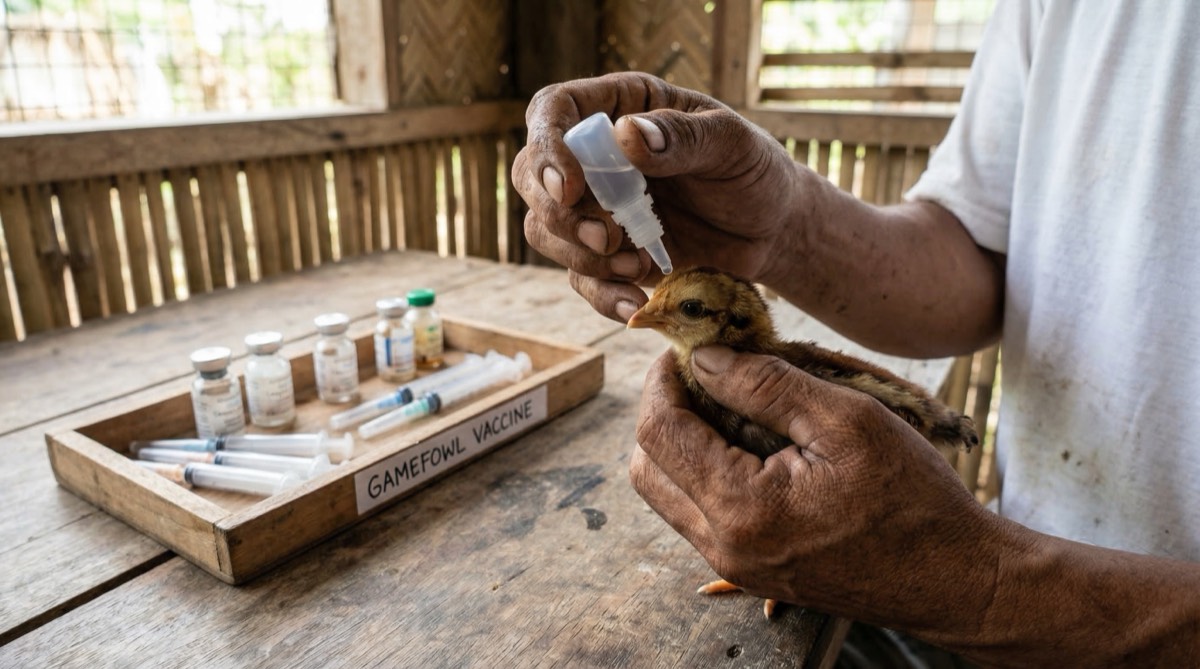
B1 Type (LaSota) is a live vaccine administered via eye drop or nasal drop. It’s a mild strain that’s safe for chicks. This is the primary vaccine used by most Filipino breeders.
Killed (Inactivated) NCD Vaccine is an injectable vaccine that provides longer-lasting immunity. It’s more expensive but offers more reliable protection. Recommended as a booster for adult gamefowl.
Schedule: First dose at day 7-10, booster at day 21-28, and regular boosters every 3-4 months for adults.
2. Fowl Pox Vaccine
Fowl Pox is common in the Philippines — especially during the wet season. It has two forms: dry pox (scabs on unfeathered areas) and wet pox (lesions in the mouth and throat, more dangerous). There’s no treatment for fowl pox — vaccination is the only prevention.
Administration: Wing web method — the vaccine is injected into the wing web using a special applicator.
Schedule: A single dose at 6-8 weeks of age. Immunity is usually lifelong.
3. Infectious Bronchitis (IB) Vaccine
Infectious Bronchitis is a respiratory disease that affects egg production in hens and can cause respiratory distress at all ages. A live vaccine is available and administered through drinking water or spray.
Schedule: First dose at day 14-21, booster at 8-10 weeks.
4. Fowl Cholera Vaccine (Optional but Recommended)
Fowl Cholera is a bacterial disease that can cause sudden death, especially in adult gamefowl. A killed vaccine is available.
Schedule: Given at 8-12 weeks of age, with a booster after 2-4 weeks.
What Is the Complete Gamefowl Vaccination Schedule?
Here’s the recommended vaccination calendar for gamefowl in the tropical Philippine climate:
Week 1 (Day 1-7)
Newcastle Disease — First Dose. B1/LaSota vaccine, eye drop or nasal drop. This is one of the most critical vaccinations — don’t skip it.
Week 2-3 (Day 10-21)
Gumboro (Infectious Bursal Disease) — if available. Not all breeders give this, but it’s recommended especially if there’s a history of Gumboro in your area.
Week 3-4 (Day 21-28)
Newcastle Disease — Second Dose (Booster). Same method as the first dose. This ensures strong immunity buildup.
Week 6-8 (Day 42-56)
Fowl Pox Vaccine. Wing web method. A one-time vaccination with usually lifelong immunity. Time it during the dry season if possible — the wet season carries a higher risk of complications at the injection site.
Week 8-12 (Day 56-84)
Fowl Cholera Vaccine (Optional). Killed vaccine, injectable. Recommended if there’s a history of cholera in the area or if you’re introducing new birds to the farm.
Infectious Bronchitis Booster. If you gave an IB vaccine at week 2-3.
Every 3-4 Months (Adults)
Newcastle Disease Booster. Regular boosters for adult gamefowl — especially important before breeding season and before derby or conditioning season.
Before Breeding Season (August-September)
Complete vaccination check. Make sure all vaccines for breeding stock are up to date before pairing. Hens with strong immunity pass maternal antibodies to chicks through the egg.
How Do You Store and Handle Gamefowl Vaccines?
Improper storage is one of the most common reasons why vaccination fails:
Temperature. Most live vaccines must be stored at 2-8°C (refrigerator temperature). Don’t freeze them and don’t expose them to direct sunlight or heat. In the hot Philippine climate, this is extra challenging — invest in a cooler box with ice when transporting vaccines from the supplier to the farm.
Expiration date. Always check the expiration date before use. Expired vaccines aren’t effective and can even cause adverse reactions.
Once opened, use immediately. Most reconstituted (mixed) live vaccines have a very short shelf life — usually only 1-2 hours after mixing. Don’t stock mixed vaccine for the next day.
Use clean equipment. Syringes, droppers, and wing web applicators must be clean and sterilized. Contaminated equipment can introduce bacteria instead of preventing disease.
Deworming Schedule (Alongside the Vaccination Program)
Vaccination isn’t just for viral diseases. Internal parasites (worms) are a common problem in chickens too. A complete health program includes regular deworming:
First deworming: 6-8 weeks of age
Regular deworming: Every 2-3 months for adults
Pre-breeding deworming: 3-4 weeks before pairing breeding stock
Post-derby deworming: After conditioning and fighting, deworm to reset health
Deworming products sold in the Philippines vary in active ingredient, and the right one depends on which parasite you are treating — see deworming for why that matters, and the medicine directory for what is in the products on the shelf. Dosage comes from the product label and from a veterinarian or agrivet, not from an article: several dewormers carry withdrawal periods for meat and eggs that must be observed.
Common Mistakes in Gamefowl Vaccination
Mistake 1: Not vaccinating because “my flock looks healthy”
Vaccination is PREVENTION — not treatment. By the time the birds are sick, it’s too late for vaccines. A healthy flock today doesn’t guarantee a healthy flock tomorrow without vaccination.
Mistake 2: Inconsistent schedule
A single dose of NCD vaccine isn’t enough for lifelong immunity. Regular boosters are needed. Many breeders vaccinate once and then forget the boosters — and are surprised when there’s an outbreak.
Mistake 3: Improper vaccine storage
As mentioned, vaccines that have been exposed to heat or have expired aren’t effective. Many breeders buy vaccines from the market displayed on a table under the sun — those vaccines are likely compromised.
Mistake 4: Vaccinating sick birds
Don’t vaccinate gamefowl that have an existing illness. Vaccination works on a healthy immune system — if the bird is sick, treat it first before vaccinating.
Mistake 5: Not isolating new birds
When you introduce new gamefowl to your farm, quarantine them for 2-4 weeks before mixing with the existing flock. This lets you observe whether they’re carrying any diseases and vaccinate them if needed.
Where Can You Buy Gamefowl Vaccines in the Philippines?
Gamefowl vaccines are available from:
Veterinary supply stores in your area are the primary source. You can find them in major towns and cities. Agricultural supply centers — especially in farming provinces — also stock common poultry vaccines. BAI regional offices sometimes have free or subsidized vaccination programs, especially for Newcastle Disease. And online agricultural stores — there are legitimate online sellers of poultry vaccines, but make sure they have cold chain delivery capability.
Note: Some vaccines are only available through prescription or authorized dealers. Your local veterinarian can guide you on sourcing.
Where Do You Buy Healthy Gamefowl?
Looking for gamefowl from breeders who follow a proper health program? See our guide on finding and vetting gamefowl breeders for how to ask about a seller’s vaccination and health practices before you buy.
Conclusion
A proper vaccination program is non-negotiable if you’re serious about gamefowl breeding. It’s not expensive (most vaccines cost only ₱50-200 per dose), but the protection it provides is worth thousands or even tens of thousands of pesos in prevented losses.
Start a vaccination program today. Don’t wait until you lose birds before taking action.
For more detailed guides on specific gamefowl diseases and treatment protocols, visit our common diseases guide — we have complete coverage of common diseases, symptoms, and step-by-step treatments.
Looking for healthy gamefowl from breeders with proper health management? See our guide to finding gamefowl breeders to find quality stock.
Frequently Asked Questions
What is the most important vaccine for gamefowl?
Newcastle Disease vaccine is the most critical — it's the number one killer of gamefowl in the Philippines, has no cure, and requires an initial dose plus regular boosters every 3-4 months for adults.
At what age should gamefowl be vaccinated?
The first Newcastle Disease dose is given at day 7-10, with a booster at day 21-28. Fowl Pox is given as a single dose at 6-8 weeks, and Infectious Bronchitis starts at day 14-21 with a booster at 8-10 weeks.
How much does gamefowl vaccination cost?
Most vaccines cost only ₱50-200 per dose, a small investment relative to the value of a breeding program worth thousands of pesos.
How should gamefowl vaccines be stored?
Most live vaccines must be kept at 2-8°C, protected from direct sunlight and heat, and used within 1-2 hours of reconstitution. A cooler box with ice is recommended for transport in the Philippine climate.
Can you vaccinate a sick gamefowl?
No. Vaccination works on a healthy immune system — a sick bird should be treated first, then vaccinated once it recovers.
How often should gamefowl be dewormed?
Adult gamefowl should be dewormed every 2-3 months, with additional deworming 3-4 weeks before pairing breeding stock and after conditioning or fighting.